Blackjack
In the conventional game described here, a hand that has not busted wins by beating the dealer’s total or surviving a dealer bust. Your choices matter, and the right basic-strategy chart depends on the rules. A winning natural on a $10 stake earns $15 net at 3:2 or $12 at 6:5: a $3 difference. That payout comparison does not establish the complete game’s house edge or guarantee a session result.
Guide text revised . Sources and assumptions are linked below.
How the game works
Count the hand
Number cards count at face value; J, Q and K count as 10. An ace counts as 1 or 11, using a total that stays at or below 21 when possible. A soft hand has an ace counted as 11. A hard hand does not.
A + 6 is soft 17. Add a 9 and it becomes hard 16: the ace now counts as 1. A soft hand cannot bust on its very next single card, but later hits can still bust it.
A natural blackjack is an initial, unsplit ace plus a ten-value card. Under the stated rules, it outranks a three-card 21. A ten-value card added to a split ace makes an ordinary 21, not a natural. Special variants can settle these hands differently.
Follow the round
- Read the rules and place the initial stake. Include any optional wagers separately.
- Receive the initial cards. In this guide’s American-style example, the dealer has an upcard and a hidden hole card. Other dealing procedures exist.
- Resolve a dealer blackjack check. With an ace or ten-value upcard, the dealer checks the hole card before players double or split. Insurance, if offered against an ace, is decided before that check.
- Choose among the permitted actions. Check whether doubling, splitting or surrender is available for this hand.
- Let the dealer follow the posted rule. The example strategy below has the dealer stand on all 17s. A hit-soft-17 table needs a different strategy.
- Settle each wager. In this conventional model, a player who busts loses even if the dealer later busts. Otherwise, a higher total wins; equal ordinary totals push and return the stake. Naturals have their separate rule.
The blackjack rules reference describes these conventional actions and common variations. A dealer who has no remaining player hand to resolve may not complete the same visible drawing sequence; the guide does not assign every observed round a universal dealer-bust frequency.
Available actions
Scroll sideways for all columns. With a keyboard, focus this table area and use the left and right arrow keys. Tab moves to the next control.
| Action | What happens | Check first |
|---|---|---|
| Hit | Add a card. | Whether further cards are allowed on this hand. |
| Stand | Keep the current total. | The hand’s soft/hard status and dealer upcard. |
| Double | Add the permitted stake and receive one final card. | Eligible totals, two-card restrictions and doubling after a split. |
| Split | Separate an eligible pair and add a stake for the new hand. | Pair definition, hand limit, resplitting and split-ace restrictions. |
| Surrender | Give up the hand for the stated partial refund. | Early versus late timing and hand eligibility. |
| Insurance | Buy a separate wager on dealer blackjack. | Its price and payout; it does not cancel the main wager. |
The dealer’s rules constrain the dealer’s actions; they do not make every future card predictable.
Bet types
Scroll sideways for all columns. With a keyboard, focus this table area and use the left and right arrow keys. Tab moves to the next control.
| Wager or settlement | Stated example | Money returned on a win |
|---|---|---|
| Ordinary main-hand win | $10 stake, 1:1 net winnings | $20 total: $10 stake plus $10 gain. |
| Winning natural at 3:2 | $10 stake | $25 total, including $15 net winnings. |
| Winning natural at 6:5 | $10 stake | $22 total, including $12 net winnings. |
| Double to $20 | $10 initial plus $10 additional stake; 1:1 win | $40 total, including $20 net winnings. |
| Split into two $10 hands | $20 committed before any later double | Each hand settles separately under its rules. |
| Insurance | $5 side stake at 2:1 net | $15 total if the dealer has blackjack; otherwise $0. |
| Late surrender | Eligible $10 initial stake after dealer blackjack is ruled out | $5 returned and $5 lost. |
| Other side bets | Named card pattern and paytable | Requires its own probabilities, payouts and stake. |
There is no universal percentage for everything called a blackjack side bet. A recognizable product name does not supply the complete paytable, deck count or settlement rules.
Read the whole rule set
Record the deck count; 3:2, 6:5 or another natural payout; dealer stand/hit on soft 17; permitted doubles; doubling after splitting; split and resplit limits; split-ace treatment; surrender timing; and what happens to additional stakes if the dealer has blackjack.
A no-hole-card game can expose doubles and split stakes to a later dealer blackjack, depending on its settlement rule. Do not apply a dealer-peek chart merely because the other table labels match. Promotional payouts and special variants also require their own analysis.
The math
House edge needs rules, strategy and a denominator
For a defined game model, expected net result is the probability-weighted average of all net outcomes. A house-edge figure commonly divides expected player loss by the initial wager. A figure dividing by all stakes, including doubles and splits, uses a different denominator. Name which one is used.
The displayed insurance figures below use the insurance stake as their denominator. They are not percentages for the main game. Neither “basic strategy” nor “average player” alone supplies a complete mathematical model or a verified population average.
As a fictional budgeting exercise, assume a game has exactly 0.5% expected loss per initial wager. One hundred rounds with $10 initial stakes give $1,000 of initial action and $5 expected loss under that assumption. Extra split/double stakes increase total action. This is arithmetic using an assumed rate, not a claim that this guide’s chart produces exactly 0.5%, a prediction of that session, or advice to complete a round target.
Compare natural payouts precisely
The difference between 3:2 and 6:5 is 0.3 units of net winnings on a paid natural, not 30% of every wager. At the same $10 stake, the difference is $3.
For a freshly shuffled six-deck model, before any cards are exposed, the player’s natural probability is 2 × 24 × 96 / (312 × 311), or 4.75%. Given that player natural, the dealer’s natural probability is 2 × 23 × 95 / (310 × 309). If simultaneous naturals push, the paid-natural probability is the first probability multiplied by one minus the second.
Holding every other rule and decision fixed, reducing the natural award from 1.5 to 1.2 net units therefore lowers expected return by about 1.36 percentage points per initial stake in this fresh-shoe model. This is a payout difference, not the complete house edge. Later shoe composition, different deck counts or different natural settlement rules require their own calculation.
Insurance depends on the remaining cards
For a 2:1 net insurance payout, let p be the chance that the hole card is ten-value given the available information. Expected net return per insurance unit is 2p − (1 − p) = 3p − 1. It breaks even at p = 1/3.
Scroll sideways for all columns. With a keyboard, focus this table area and use the left and right arrow keys. Tab moves to the next control.
| Fresh six-deck example; dealer ace exposed | Ten-value cards / possible hole cards | Expected loss / insurance stake |
|---|---|---|
| No other card identities observed | 96 / 311 | 7.40% |
| Player also sees two ten-value cards | 94 / 309 | 8.74% |
| Player also sees a 5 and a 6 | 96 / 309 | 6.80% |
These conditional examples show why an approximate 7.7% is not universal. All three stated expectations are negative for the player. A basic-strategy chart declines insurance without a composition-based insurance calculation; a remembered winning or losing streak alone does not supply p.
At a 3:2 table, a player natural with a $10 main stake plus $5 insurance earns $10 net whether the dealer has blackjack or not: either the main wager pushes and insurance gains $10, or the natural gains $15 and insurance loses $5. This explains the conventional “even money” offer. That same arithmetic does not carry over unchanged to a 6:5 natural payout.
A rule-specific basic-strategy reference
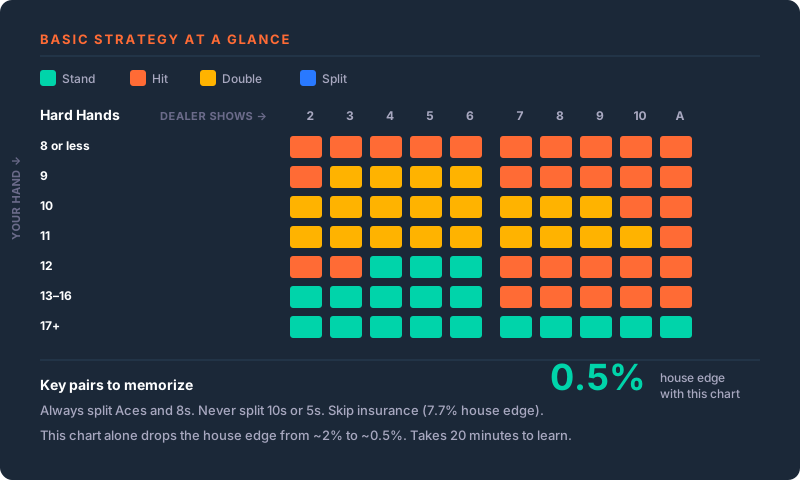
The following is a total-dependent 4–8-deck reference with dealer stand on soft 17, a dealer peek for blackjack, double on any initial two cards, double after splitting, and late surrender. It follows the mathematical decisions in the matching strategy reference. This is not a chart for every variant or a composition-dependent calculation using every exposed card.
Use the pair table first when splitting is permitted; otherwise use the hard or soft total. Apply surrender only to an eligible initial hand after dealer blackjack has been ruled out. Split aces in this example get one further card; obey that restriction instead of using a hit/double cell. If a split limit is reached, use the total table and the actions still permitted.
Scroll sideways for all columns. With a keyboard, focus this table area and use the left and right arrow keys. Tab moves to the next control.
| Code | Action and fallback |
|---|---|
| H | Hit. |
| S | Stand. |
| Dh | Double if permitted; otherwise hit. |
| Ds | Double if permitted; otherwise stand. |
| P | Split, when an additional hand is permitted. |
| Rh | Late surrender if permitted; otherwise hit. |
Hard totals
Scroll sideways for all columns. With a keyboard, focus this table area and use the left and right arrow keys. Tab moves to the next control.
| Your hand / dealer upcard | 2 | 3 | 4 | 5 | 6 | 7 | 8 | 9 | 10 | A |
|---|---|---|---|---|---|---|---|---|---|---|
| 4–8 | H | H | H | H | H | H | H | H | H | H |
| 9 | H | Dh | Dh | Dh | Dh | H | H | H | H | H |
| 10 | Dh | Dh | Dh | Dh | Dh | Dh | Dh | Dh | H | H |
| 11 | Dh | Dh | Dh | Dh | Dh | Dh | Dh | Dh | Dh | H |
| 12 | H | H | S | S | S | H | H | H | H | H |
| 13 | S | S | S | S | S | H | H | H | H | H |
| 14 | S | S | S | S | S | H | H | H | H | H |
| 15 | S | S | S | S | S | H | H | H | Rh | H |
| 16 | S | S | S | S | S | H | H | Rh | Rh | Rh |
| 17–21 | S | S | S | S | S | S | S | S | S | S |
Soft totals
Scroll sideways for all columns. With a keyboard, focus this table area and use the left and right arrow keys. Tab moves to the next control.
| Your hand / dealer upcard | 2 | 3 | 4 | 5 | 6 | 7 | 8 | 9 | 10 | A |
|---|---|---|---|---|---|---|---|---|---|---|
| A + 2 (13) | H | H | H | Dh | Dh | H | H | H | H | H |
| A + 3 (14) | H | H | H | Dh | Dh | H | H | H | H | H |
| A + 4 (15) | H | H | Dh | Dh | Dh | H | H | H | H | H |
| A + 5 (16) | H | H | Dh | Dh | Dh | H | H | H | H | H |
| A + 6 (17) | H | Dh | Dh | Dh | Dh | H | H | H | H | H |
| A + 7 (18) | S | Ds | Ds | Ds | Ds | S | S | H | H | H |
| 19–21 | S | S | S | S | S | S | S | S | S | S |
Pairs, when another split is permitted
Scroll sideways for all columns. With a keyboard, focus this table area and use the left and right arrow keys. Tab moves to the next control.
| Your hand / dealer upcard | 2 | 3 | 4 | 5 | 6 | 7 | 8 | 9 | 10 | A |
|---|---|---|---|---|---|---|---|---|---|---|
| 2 + 2 | P | P | P | P | P | P | H | H | H | H |
| 3 + 3 | P | P | P | P | P | P | H | H | H | H |
| 4 + 4 | H | H | H | P | P | H | H | H | H | H |
| 5 + 5 | Dh | Dh | Dh | Dh | Dh | Dh | Dh | Dh | H | H |
| 6 + 6 | P | P | P | P | P | H | H | H | H | H |
| 7 + 7 | P | P | P | P | P | P | H | H | H | H |
| 8 + 8 | P | P | P | P | P | P | P | P | P | P |
| 9 + 9 | P | P | P | P | P | S | P | P | S | S |
| 10 + 10 | S | S | S | S | S | S | S | S | S | S |
| A + A | P | P | P | P | P | P | P | P | P | P |
The reference makes distinctions that a broad “dealer 2–6” column can hide: hard 9 hits against 2; soft 15 doubles against 4 when allowed; soft 18 stands against 2; and a pair of 4s splits against 5 or 6 when doubling after splitting is permitted. Pair 9s stand against 7 even though they split against 8 or 9.
An action with the highest expected return can still have a negative expectation. For example, the infinite-deck action tables compare several losing-expectation choices for 8 + 8 against a dealer 10. “Best available choice” does not mean a profitable or guaranteed-winning hand. Those infinite-deck results are a separate model from a finite shoe: that model hits soft 13 against 5 and soft 15 against 4, where the finite 4–8-deck reference above doubles when permitted.
A finite shoe changes as cards leave
Cards dealt from a shoe are not immediately replaced. Removing a ten-value card changes the composition available for later draws. Shared cards and the dealer also connect hands at a table. It is inaccurate to promise that each player’s finite-shoe hand is independent of all the others.
This does not mean that a neighbor who took a particular card reliably caused a future loss, or that dealer streaks establish the next result. Knowing visible composition and predicting an exact unknown card are different claims. No card-counting income, venue permission or legal conclusion is promised here.
Compare scoped measures in the game comparison.
Tips for informed play
- Match the chart to the rules. Check dealer peek, soft 17, doubling, splitting and surrender before relying on a cell.
- Read net and total payouts separately. A $15 gain plus a returned $10 stake is $25 total.
- Count extra commitments. A split or double changes the amount at risk.
- Treat insurance as its own wager. The main hand’s appearance does not make an arbitrary insurance price fair.
- Set spending and time limits before play. No fixed bankroll percentage or number of hands makes a negative expectation disappear.
- Practice interpreting the chart. There is no promised learning time, guaranteed edge reduction or requirement to keep playing so strategy can “work.”
Sources and scope
- Blackjack rules and payout variations: Michael Shackleford’s mathematical and game-rule reference. It does not verify a particular venue’s current offer.
- 4–8-deck basic strategy: source for the decision facts in the rule-specific hard, soft and pair tables. Action availability and the guide’s stated limits apply.
- Infinite-deck action returns: a separate model illustrating that a highest-return action can still have negative expectation; not a finite-shoe return calculation.
- Payout comparisons, conditional insurance counts and the fresh-six-deck natural-payout difference are independently calculated teaching examples. The assumed 0.5% budgeting exercise is explicitly fictional. No new whole-game finite-deck strategy solver or measured player outcome is claimed.
Sources checked September 6, 2026. This edition replaces this site’s earlier generalized ranges and simplified strategy claims. Check actual rules, contacts and local requirements before adapting the text.
Key terms
- Natural blackjack
- Initial unsplit ace plus a ten-value card under this guide’s conventional rules.
- Ordinary 21
- A 21 that does not receive the natural’s special settlement.
- Bust
- A total above 21; the conventional player wager loses immediately.
- Soft hand
- A hand using an ace as 11 without exceeding 21.
- Hard hand
- A hand with no ace currently counted as 11.
- Upcard
- The dealer’s visible initial card.
- Hole card
- A dealer card dealt face down.
- Dealer peek
- A check for dealer blackjack before later player actions.
- Hit
- Take another permitted card.
- Stand
- End drawing on the current hand.
- Double
- Add the permitted wager and receive one final card.
- Split
- Separate an eligible pair into hands with separate stakes.
- DAS
- Double after splitting is allowed under the stated restrictions.
- Push
- A settlement returning the stake with no net gain or loss.
- Insurance
- A separate wager on dealer blackjack, commonly at a stated 2:1 net payout.
- Late surrender
- An eligible partial refund after dealer blackjack has been ruled out.
- Shoe
- A supply of cards from one or more decks used for dealing.
- Initial action
- Sum of original wagers, excluding later added split/double stakes.
- Total action
- Sum of all wagers, including added stakes.
- Basic strategy
- A rule-specific decision reference based on hand information and expected returns.
Common myths
What people believe, and what probability tells us.
Myth
Every basic-strategy game has a 0.5% edge
The reality
Rules, strategy and the denominator determine the figure.
Myth
Every 21 is a natural blackjack
The reality
Initial unsplit naturals have a separate settlement rule.
Myth
Insurance always has exactly the same percentage
The reality
Its probability depends on the cards and information in the stated model.
Myth
A stronger choice guarantees a profitable hand
The reality
The least costly available action can still have negative expectation.
Myth
Every hand from a shoe is independent
The reality
Cards leave the finite shoe, and hands share the dealer and card supply.
Myth
A fixed betting progression removes the house edge
The reality
Changing stakes does not by itself change the expected return of a given wager.
Knowledge check
Pick an answer to reveal the explanation. Nothing is scored or saved.
Part of the Playbook Brand system, the open, public-domain core for player education. You can copy and adapt it under CC0.