Roulette
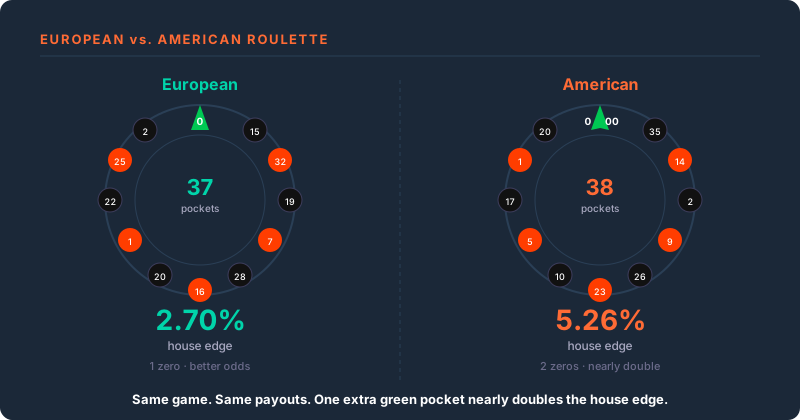
Your choice of bet changes the chance of a payout, its size and the amount at risk. With conventional payouts and no zero concession, single-zero roulette has 2.70% house edge and double-zero roulette has 5.26%. Two important exceptions are the double-zero five-number basket at 7.89% and single-zero even-money bets with half returned on zero at 1.35%. Read the actual wheel and paytable.
Guide text revised . Sources and assumptions are linked below.
How the game works
Identify the wheel and rules
Scroll sideways for all columns. With a keyboard, focus this table area and use the left and right arrow keys. Tab moves to the next control.
| Example | Pockets | What else to check |
|---|---|---|
| Single zero | 37: 0 and 1–36 | Payouts and the treatment of zero on even-money bets. |
| Double zero | 38: 0, 00 and 1–36 | Payouts, zero concessions and the separate five-number basket. |
| Half back on zero | Here, a single-zero wheel | Only the specified even-money wagers get half their stake back on zero. |
| Imprisonment / en prison | Here, a single-zero wheel | Whether the stake is held, how it is released, and what another zero does. |
Names such as European, American or French are useful labels, but the actual pockets and settlement rules determine the calculation. Other wheels, bonus games and altered payouts need their own analysis.
On these examples, 18 of the numbered pockets are red and 18 are black. Zero and double zero are separate outcomes; they do not win red/black, odd/even or high/low wagers under the ordinary full-loss-on-zero rules.
Reference: roulette rules, payout tables and zero-rule variants.
Follow a round
- Check your stake and selections. One spin can carry several bets. Add their costs rather than treating the chips as one unit wager.
- Place bets before the cutoff. Follow the dealer’s or game’s betting window; after it closes, the accepted bets stand under the rules.
- Read the official result. In a ball-and-wheel game, the settled pocket supplies the winning number. Electronic and other versions need their own result rules.
- Check the payout. A winning chip may return both net winnings and the original stake. Read whether a displayed amount includes that stake.
- Decide whether to play another round. Previous results do not make a particular pocket due in the independent, uniform model used here.
Net winnings and total return
A payout of 35 to 1 means $35 net winnings for a winning $1 stake, plus that $1 returned: $36 in total. 35 for 1 instead means $35 total, including the stake. Those are different payouts and produce different expected returns. Do not read a large displayed number without its units.
Bet types
The following net payouts describe the conventional examples in this guide. A win also returns the stake. Check which combinations the actual layout permits.
Scroll sideways for all columns. With a keyboard, focus this table area and use the left and right arrow keys. Tab moves to the next control.
| Bet | Selection | Winning pockets | Net payout |
|---|---|---|---|
| Straight up | One pocket | 1 | 35:1 |
| Split | Two eligible adjoining layout numbers | 2 | 17:1 |
| Street | One row of three | 3 | 11:1 |
| Corner | Four eligible numbers sharing a corner | 4 | 8:1 |
| Six line | Two adjoining rows | 6 | 5:1 |
| Dozen | 1–12, 13–24 or 25–36 | 12 | 2:1 |
| Column | One layout column | 12 | 2:1 |
| Red / black | The chosen color | 18 | 1:1 |
| Odd / even | The chosen category among 1–36 | 18 | 1:1 |
| Low / high | 1–18 or 19–36 | 18 | 1:1 |
| Five-number basket | Double-zero 0, 00, 1, 2, 3 | 5 | 6:1 |
More covered pockets increase a bet’s chance of winning but the corresponding payout is smaller. This does not automatically reduce its house edge. On the conventional single-zero examples above, all listed bets available on that wheel have the same edge before zero concessions. The double-zero basket, altered payouts and special zero rules must be calculated separately.
The math
Keep the measure and rule together
Scroll sideways for all columns. With a keyboard, focus this table area and use the left and right arrow keys. Tab moves to the next control.
| Stated example | House edge | Scope |
|---|---|---|
| Single zero | 2.70% | 37 equal pockets, conventional payouts, full loss on zero for even-money wagers. |
| Double zero | 5.26% | 38 equal pockets, conventional payouts; basket excluded and no zero concession. |
| Double-zero basket | 7.89% | Five winning pockets; 6:1 net payout. |
| Single-zero half back | 1.35% | Even-money wagers only; half the stake returned on zero. |
For a $1 wager that either wins or loses, expected net return is win probability × net payout − loss probability. House edge is the negative of that expected return, expressed as a percentage of the stake. A push or partial loss adds its own outcome term.
A straight-up wager
On the stated single-zero wheel, a chosen pocket wins once among 37 equally likely outcomes. Winning pays $35 net; the other 36 outcomes lose $1. Expected net return is (35 − 36) / 37 = −1/37 per $1, giving 2.70% house edge.
On the stated double-zero wheel, it is (35 − 37) / 38 = −2/38, giving 5.26%. This is an expected-loss percentage, not the probability that every particular player loses during a visit.
The basket has five winning pockets
The basket’s win probability is 5/38, or 13.16%. With 6:1 net winnings, its expected net return is (5 × 6 − 33) / 38 = −3/38. Its house edge is therefore 7.89%. The win probability and house edge answer different questions.
Red is not a 50% event
On the single-zero example, red wins on 18 of 37 pockets: 48.65%. On double zero it is 18 of 38: 47.37%. Red and black can be equally likely without either having a 50% probability, because the zero outcomes remain.
Under independent spins with unchanged probabilities, a run of black results does not change those next-spin fractions. A short result history does not itself establish that a wheel is biased or that a pattern is useful. This guide does not claim an empirical equipment test of a particular game.
Half back and imprisonment are different rules
For single-zero even-money bets with half back on zero, there are 18 outcomes winning $1, 18 losing $1 and one losing $0.50. Expected net return is (18 − 18 − 0.5) / 37, giving 1.35% house edge.
An imprisonment rule holds a stake instead of immediately returning half. Its result depends on the release and repeat-zero rules. Do not assign every rule called en prison the half-back percentage. Nor does half back improve a straight-up wager that is outside the concession’s scope.
Total amount wagered matters
For a fixed $100 of total wagers in the stated single-zero model, expected loss is about $2.70. For the double-zero model it is about $5.26. These figures concern total action, including money bet again, rather than only the cash brought to the table. Actual results vary.
Betting progressions do not change the expected result per dollar on the same unchanged bet. Doubling after losses changes stake size and exposure. For example, losses on $5, $10, $20, $40, $80 and $160 wagers total $315; the next doubled wager would require another $320. Neither the available funds nor the table limit is unlimited. No promised recovery follows from the sequence.
Compare measures in the game comparison.
Tips for informed play
- Read the pockets and paytable together. Wheel type alone does not establish the edge for every bet or bonus feature.
- Read the zero rule’s scope. Half back on eligible even-money wagers does not apply to all selections.
- Keep chance, payout and expected loss separate. A bet that wins more frequently can still have the same proportional expected loss.
- Add all chips in the round. Several simultaneous selections can increase total spend even if one of them wins.
- Choose a spending and time limit beforehand. A previous loss does not create an obligation to increase the next wager or play another spin.
Sources and scope
- Shackleford: roulette rules, payouts and zero-rule variants. Original published mathematical analysis, used to check the stated payout and settlement examples.
- All displayed probability, edge, spending and progression examples are calculated from their specified inputs. They do not establish the fairness, availability or pace of a particular game.
Checked September 5, 2026. Calculations assume equally likely pockets and independent spins. Check different wheels, altered payouts, multipliers and zero concessions separately.
Key terms
- One possible settled wheel result in the stated model.
- Single zero
- A wheel with 0 and the 36 numbered pockets.
- Double zero
- A wheel with 0, 00 and the 36 numbered pockets.
- Inside bet
- A selection placed on particular numbers or small eligible groups.
- Outside bet
- A selection such as a color, dozen or column.
- Straight up
- A wager on one pocket. Its payout must be read from the paytable.
- Basket
- Here, the double-zero 0, 00, 1, 2, 3 combination.
- Even-money wager
- A wager paying one unit of net winnings per unit staked when it wins.
- La partage / half back
- The stated rule returning half an eligible even-money stake on zero.
- En prison / imprisonment
- A rule holding a stake after zero; release and repeat-zero terms matter.
- Net winnings
- The gain on a winning wager, excluding the returned stake.
- Total return
- The settlement amount including any returned stake.
- House edge
- Expected net loss divided by stake under specified rules and probabilities.
- Total action
- The sum wagered, including funds staked more than once.
- Croupier
- The dealer running the table and applying its procedures.
Common myths
What people believe, and what probability tells us.
Myth
Wheel choice is the only decision that matters
The reality
The selected wager, payout, zero rules and total stake also matter.
Myth
Red is due after a run of black
The reality
Unchanged independent spins retain the same next-spin probabilities.
Myth
Equally likely red and black means 50/50
The reality
Zero outcomes prevent either color from covering half the wheel.
Myth
Every wager everywhere has the same edge
The reality
The basket, zero concessions and altered payouts need separate calculations.
Myth
Doubling guarantees recovery
The reality
A progression changes exposure and can run into funds or table limits.
Myth
A lower house edge guarantees this session’s profit
The reality
Expected value is a model average, not a promised visit result.
Knowledge check
Pick an answer to reveal the explanation. Nothing is scored or saved.
Part of the Playbook Brand system, the open, public-domain core for player education. You can copy and adapt it under CC0.