Slots
If a game’s theoretical RTP is 95%, its corresponding house edge is 5.00% under that defined model. It does not mean a 95% chance of a prize, a guaranteed session return, or repayment of 95% of a deposit. Check the actual game configuration and full stake. Independent, unchanged paid rounds do not become due after losses; features or different machine mechanisms need their own rules.
Guide text revised . Sources and assumptions are linked below.
How the game works
Follow a paid round
- Identify the game and settings. Read the displayed help, prize table, stake setting and any stated RTP or feature conditions.
- Check the total cost. Count denomination, credits, active lines and additional feature costs as the game defines them. Not every game uses lines × stake per line.
- Confirm the round. In a conventional random reel game, random inputs are mapped to outcomes under the rules. Visible symbols need not be equally likely.
- Read the complete award. Line wins, scatter awards and any triggered feature may contribute to the return. A single animation need not represent the entire paid round.
- Compare money returned with money spent. A payout smaller than the round’s cost is a net loss, even if the screen celebrates it.
A paytable can describe winning combinations without revealing their probabilities. Seeing the same symbol on a reel more than once does not by itself establish every virtual stop’s weight or the chance of a complete combination. This guide does not assert a universal RNG timing, sub-millisecond result, or mechanical design for every machine called a slot.
Random rounds and changing game states
For an independent-round model with unchanged settings and state, the conditional distribution of the next round is unchanged by earlier wins or losses. Waiting for a streak to end does not improve that model’s probabilities.
That statement needs its scope. A feature can carry a collected symbol or another state into its next step; a bonus can have different rules from the base game. A changing jackpot or separately priced option can also change the return being calculated. Such information is not the same as a promise that losses force a win.
The Gambling Commission’s machine explanation distinguishes random and compensated machines in Great Britain. Its remote standard, RTS 7, prohibits adaptive compensation in its applicable remote games while allowing specified randomly triggered features with different rules. These sources concern their named settings; they do not certify every game worldwide or establish a particular game’s next result.
Understand the feature before including its prize
Scroll sideways for all columns. With a keyboard, focus this table area and use the left and right arrow keys. Tab moves to the next control.
| Feature or format | What to inspect |
|---|---|
| Paylines | Which paths are active, symbol order and whether awards can overlap. |
| Ways / cluster pays | The game’s matching and counting rule; a “way” is not a promised independent chance. |
| Wilds / scatters | Substitution exclusions, qualifying positions and how awards combine. |
| Awarded spins / bonus rounds | Qualifying event, included stake value, altered rules and the end of the feature. |
| Progressive jackpot | Eligibility, contribution or funding terms, prize value and reset conditions. |
| Feature purchase / extra stake | Full added cost, the purchased outcome distribution and applicable terms. |
No universal jackpot odds or percentage contribution is assigned to these names. An award described as “free spins” can be part of a paid game’s expected return or a separate promotion with conditions. Keep those contexts distinct and avoid counting the same feature payout twice.
Bet types
Denomination is not the total stake
Scroll sideways for all columns. With a keyboard, focus this table area and use the left and right arrow keys. Tab moves to the next control.
| Setting | Meaning | Cost implication |
|---|---|---|
| Credit denomination | Monetary value of one credit. | One credit can be worth more or less than one dollar. |
| Credits per line | Credits applied to each active line, if used. | Multiply by the number of paid lines and denomination. |
| Fixed total bet | The game’s stated complete round stake. | Use the total, rather than multiplying it by lines again. |
| Optional additional wager | A separately priced feature or eligibility change. | Include the full added amount. |
| Maximum setting | The largest offered setting under the product’s rules. | It is not a spending target or a universal jackpot requirement. |
A hypothetical 20-line game with five credits per line and a $0.01 credit costs 20 × 5 × $0.01 = $1 per round. A “penny” credit does not make that purchase one cent.
If all payouts scale exactly with the stake while probabilities stay fixed, multiplying the stake scales the money won and lost without changing RTP. If a setting changes eligibility, awards, game state or probability, recalculate the model. Neither “larger bets always improve the odds” nor “bet settings never affect the math” is a reliable universal rule.
Read a partial return
Suppose a $1 paid round returns $0.40 in total awards. The net result is +$0.40 − $1 = −$0.60. Several paying lines do not establish a profitable round. Check whether displayed numbers mean credits, money, total awards or net gain.
The math
Theoretical RTP is an expectation
For a specified fixed-stake round, theoretical RTP is expected total awards / stake × 100. House edge is 100% − RTP when the calculation includes the same costs, outcomes and conditions. Feature awards must be included once in the appropriate round or complete feature-cycle model.
A hypothetical 95% RTP therefore corresponds to 5.00% expected loss per amount wagered. It is not a balance floor, repayment deadline, or a promise that the machine will eventually pay any particular person back.
An observed payout ratio instead divides actual awards by actual stakes over a stated sample. It can differ from theoretical RTP. The sample’s length, stakes and game settings matter; a short session does not establish the programmed distribution.
The regulator’s RTP explanation describes an average across many plays, not a guaranteed return during a session. This guide does not infer a universal online, casino-floor or progressive RTP range from that explanation.
Total action differs from starting money
For an illustrative fixed plan of 200 paid rounds at $0.5 each, total action is $100. Under an unchanged 95% return model, expected total awards are $95 and expected net loss is $5. This assumes the stated number of rounds is completed; it is not a play target or a promise that a particular budget can fund it.
Starting with $20, making ten $1 wagers and receiving $8 total leaves $18. In that actual arithmetic example, the observed award/stake ratio is 80%, while the ending balance is 90% of the starting balance. Those percentages have different denominators. Rewagering returned money adds action without adding the same amount of new deposits.
Same RTP, different payout distributions
These are three invented models, not available games. Each round costs one unit and independently selects one of 100 equally likely labels with replacement. The following rows give the complete total-return distributions:
Scroll sideways for all columns. With a keyboard, focus this table area and use the left and right arrow keys. Tab moves to the next control.
| Model | Complete distribution across the 100 outcome labels | RTP | Any positive award | Award greater than the one-unit stake |
|---|---|---|---|---|
| A | 10 return 0; 85 return 1; 5 return 2 | 95% | 90% | 5% |
| B | 99 return 0; 1 returns 95 | 95% | 1% | 1% |
| C | 10 return 0; 89 return 1; 1 returns 6 | 95% | 90% | 1% |
Each model averages 0.95 units returned per unit staked. A and C both have a 90% chance of some award, but different profitable-round rates and different variability. In A, 85% of rounds merely return the stake. A prize frequency is not a profit frequency.
Using variance as the explicit measure, A has 0.1475 squared units, B has 89.3475, and C has 0.3475. Thus C varies more than A despite the same RTP and same any-award frequency. Informal “low” or “high” volatility labels do not, by themselves, supply a complete prize distribution or a guaranteed session length.
A dry run is not a repayment schedule
In model B, each independent paid round has a 1% chance of its 95-unit award. The probability of no award in ten rounds is (99/100)^10, about 90.44%. Conditional on those ten losses, the next unchanged independent round still has a 1% award chance. The 95% RTP never meant a 95% chance of a prize.
This exercise is not a model for every bonus, compensated machine or changing prize state. A displayed near miss is not enough information to calculate the next round’s probability; use the actual rules and state, not how close an animation looks.
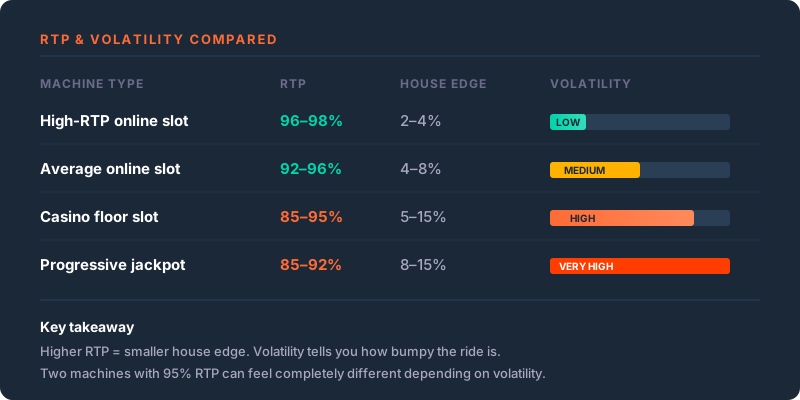
Compare defined measures in the game comparison.
Tips for informed play
- Read the full cost first. A denomination or per-line amount can be much smaller than the total purchase.
- Look for game-specific information. Check the actual configuration, prize rules, RTP scope and feature eligibility. Do not infer missing odds from the theme.
- Compare awards with costs. An animation or a paying line does not establish a net gain.
- Keep probability claims conditional. An unchanged independent model differs from a retained feature state or another machine mechanism.
- Choose time and spending limits before play. A lower variance or higher RTP does not guarantee that a budget lasts.
- Count repeated wagers. More paid rounds or larger stakes increase action; no universal spin speed or hourly-loss prediction is supplied here.
Sources and scope
- Return to player; random and compensated machines: Gambling Commission explanation for Great Britain, including why an RTP is not a session guarantee and why machine mechanism matters.
- Remote standard RTS 7: the named remote-game standard addresses randomness, adaptive compensation and specified bonus features. This is a scoped regulatory source, not evidence of every game’s compliance worldwide.
- The complete 100-label payout models, variance calculations, independent-draw exercise and cash-flow examples are Playbook RG teaching examples. They are not actual offered games, measured player results, universal volatility bands or estimates of typical game speed.
Sources checked September 6, 2026. No current game-specific RTP, jackpot probability, live machine certification or worldwide legal conclusion is asserted. Check the actual product rules and local requirements before adapting this edition.
Key terms
- Stake
- Total amount paid for the stated round or purchase.
- Denomination
- Monetary value of a credit.
- Total action
- Sum of all stakes, including money wagered again after an award.
- Total awards
- All amounts returned for the scope being measured.
- Net result
- Total awards minus all relevant stakes and costs.
- Theoretical RTP
- Expected awards divided by stakes in a specified mathematical model.
- Observed payout ratio
- Actual awards divided by actual stakes over a stated sample.
- House edge
- Expected loss as a percentage of the stated wager denominator.
- RNG
- A random-number process used by a game under its outcome rules.
- Paytable
- A description of qualifying results and awards; it may not disclose probabilities.
- Payline
- A defined symbol path used by a line-based game.
- Wild
- A symbol that can substitute under the game’s specified exceptions.
- Scatter
- A symbol awarded or counted under a specified position rule.
- Hit frequency
- Here, the chance of any positive award, including one smaller than the stake.
- Profitable round
- A round whose total awards exceed its full cost.
- Variance
- Probability-weighted squared deviation from the mean return.
- Volatility
- A description of payout variability; the label alone is not a full probability table.
- Independent rounds
- Rounds whose probabilities are unaffected by earlier results under the stated model.
- Game state
- Information retained by the rules that can affect the next stage or award.
- Progressive jackpot
- An award whose value changes under its specified funding and reset rules.
Common myths
What people believe, and what probability tells us.
Myth
95% RTP means a prize on 95% of rounds
The reality
Expected return and prize frequency are different measures.
Myth
A paying animation proves a profit
The reality
Total awards can be smaller than the full stake.
Myth
The machine must repay my losses
The reality
An expected return is not an individual repayment schedule.
Myth
Every slot everywhere has identical independent rounds
The reality
Features, settings and machine mechanisms need their own rules.
Myth
The maximum setting always has the same mathematics
The reality
Eligibility, prices and awards may change with the setting.
Myth
Low volatility guarantees a longer session
The reality
Variability alone does not determine a session’s result or length.
Knowledge check
Pick an answer to reveal the explanation. Nothing is scored or saved.
Part of the Playbook Brand system, the open, public-domain core for player education. You can copy and adapt it under CC0.