Brand foundation
Scope, intent, and vision; the brand pillars, positioning, value propositions, and key audiences.
18 min read · Free to copy and adapt · CC0
Revised . Game examples revised with stated rules and shared calculations. Confirm local game and service details before adapting copy.
Download this chapter (.md)This chapter is the bedrock. Everything else in this system – every headline, every feature description, every social post, every quiz question – traces back to the decisions made here. If you’re onboarding a new team member, setting strategic direction, or resolving a “should we do X?” debate, this is the chapter you reference.
Read it once all the way through. Bookmark the pillars section. Come back to positioning whenever you’re uncertain about scope.
Brand Scope
What Playbook Is
Playbook is a content/media brand. Specifically, it’s the educational and awareness layer of the gambling entertainment experience.
That means Playbook creates content. Articles, social posts, quizzes, myth-busters, feature descriptions, onboarding copy, in-product messaging, venue signage, video scripts, infographics, interactive tools. Content that helps players understand how gambling works, make smarter decisions, and enjoy their play more.
What Playbook Doesn’t Do
Playbook has clear boundaries. Respecting them keeps the brand focused and prevents scope creep into areas where Playbook has no expertise and no business.
Playbook doesn’t operate helplines. If a player needs to talk to someone, Playbook provides the number. It doesn’t answer the phone.
Playbook doesn’t provide treatment. It’s not therapy. It’s not counseling. It’s not a clinical program. If a player needs professional support, Playbook points them there – clearly, warmly, immediately. But it doesn’t pretend to be a substitute for qualified professionals.
Playbook doesn’t enforce regulations. It operates within regulatory frameworks. It doesn’t set them, interpret them, or enforce them. Compliance teams verify. Playbook creates.
Playbook is gambling-neutral. It doesn’t promote gambling and it doesn’t discourage it. The goal is informed play, not more play or less play. Playbook provides information and tools – what players do with them is their call.
Think of it this way: Playbook is to gambling what a nutrition label is to food. It doesn’t tell you what to eat. It gives you the information to make your own choices.
Intent
Playbook gives players the information and tools to gamble on their own terms – making informed play feel natural, not forced.
This is the sentence that should be pinned to every content brief, every design review, every editorial calendar. Everything Playbook creates should be traceable back to this statement.
Unpacking the Intent
“gives players” – The player is the subject. Not the operator. Not the regulator. Not the brand. The player receives something of value.
“the information and tools” – Two deliverables. Information (how games work, what the odds mean, why myths are myths) and tools (deposit limits, session timers, spending trackers – reframed as features). Both are required.
“to gamble on their own terms” – Autonomy. The player decides. Playbook doesn’t set the terms. It provides the ingredients for the player to set their own.
“making informed play feel natural, not forced” – The experience goal. Knowing the odds, setting a budget, checking your session time – these should feel like things you want to do, like checking the weather or reading reviews before a purchase. Not something imposed on you by a compliance requirement.
Customizing the Mission
When adapting for your organization, keep three principles:
- Lead with the player. “We help players...” not “We are committed to...” or “Our company believes in...” The player is the protagonist, not your brand.
- Include education and tools. Both matter. Information without tools is academic. Tools without information are opaque. The mission needs both.
- Avoid obligation language. “We are required to provide...” is a compliance statement, not a mission. If your mission reads like it was written to satisfy a regulator, rewrite it until it reads like it was written to serve a player.
Template: ”[Brand name] gives players [what] to [outcome] – making [how it feels].”
Vision
An open-source marketing communications platform that any operator can adopt to make gambling literacy a natural part of the player experience – reaching more players, earlier, with content they actually engage with.
The vision has three parts:
Open-source platform. Playbook is designed to be forked, customized, and deployed by any operator in any market. The brand system, content frameworks, and design assets are freely available. This isn’t a proprietary program locked behind a vendor relationship – it’s shared infrastructure for an industry that needs it.
Reach more players, earlier. Most gambling education reaches players too late – after problems have developed, after patterns have set in. By creating content that’s genuinely engaging, Playbook reaches players during the entertainment experience itself, building awareness and literacy before it’s urgent.
Content they actually engage with. Right now, there’s a quality canyon between the entertainment product and the educational content around it. The slot game has world-class animation, sound design, and user experience. The player education page has a wall of text in 11-point font with a stock photo of someone looking pensive. Players notice the gap. When the educational content matches the quality of the entertainment product, players stop categorizing it as a warning and start treating it as a feature.
What the Vision Implies
- Player education content deserves real design investment – not leftover budget, not intern projects, not templates from three years ago.
- The benchmark for quality is the entertainment product itself. If your myth-buster quiz looks worse than your sportsbook’s betting interface, you haven’t met the standard.
- Engagement is the success metric. Not compliance. Not “did we publish it?” but “did players use it?”
- The open-source model means improvements compound across the industry. One operator’s contribution benefits every other adopter.
Two Brand Pillars
Everything Playbook creates passes through two filters. If a piece of content doesn’t serve at least one pillar, it doesn’t ship. If it contradicts either pillar, it gets rewritten.
These are the pillars in full. The Introduction previewed them. This is the complete specification – enough detail that a content creator could start writing immediately.
Pillar 1: OPEN – “No Fine Print”
Transparency. The math is public. Now you know it.
Open is the honesty pillar. It’s about making sure players have access to the information that’s been hiding in plain sight – house edges, odds, T&Cs, game mechanics – and presenting it in a way that’s actually understandable.
The gambling industry has a transparency problem. Not because the information is secret – most of it is technically available – but because it’s presented in ways that make it functionally inaccessible:
- House-edge information buried in help files that are difficult to find
- Odds presented in formats most players can’t intuitively parse
- Terms and conditions written in legalese designed to protect the operator, not inform the player
- Bonus wagering requirements calculated in ways that obscure the real value
Open means fixing that. Not by demanding that operators change their products (that’s a regulator’s job), but by creating content that explains what’s already there in clear, natural language.
Open Content Examples
House edge transparency:
Instead of: “Games carry varying degrees of house advantage. Please consult the game rules for specific return-to-player information.”
Write: “In a hypothetical game with 95% theoretical RTP, the house edge is 5.00% on the same stake denominator. That describes an average, not the result of your session. Blackjack depends on the table rules and strategy; Slots depend on the actual game’s payout model. Check the game and bet before comparing numbers.”
Source and scope: Use the Slots guide and Blackjack guide. The regulator’s RTP explanation distinguishes return from a session promise and retains its British machine scope.
Promotional T&Cs:
Instead of: “This offer is subject to terms and conditions. 40x wagering requirements apply. See full terms.”
Write: “If a hypothetical 40x requirement applies only to a $50 bonus, and each eligible dollar counts in full, it requires $2,000 of qualifying action. At a constant assumed 3% house edge, expected net loss over that fixed action is $60. That is not a prediction of your result or a valuation of the bonus. Check the full terms, including eligible games, contribution rates, maximum bets and expiry.”
Calculation scope: This assumes the full action is completed. It does not establish the probability of completion or an amount available for withdrawal. A requirement on bonus plus deposit, a changing balance or other stopping rules needs its own analysis. See wagering requirements.
Odds explanation:
Instead of: “Jackpot odds: one in hundreds of millions.”
Write: “Mega Millions uses five different numbers from 70 and one Mega Ball from 24. A single selection has a 1-in-290,472,336 chance of matching all six. That is the jackpot chance, not the chance of any prize. If more than one ticket wins the jackpot, the prize is shared.”
Source and scope: Official Mega Millions rules, checked September 6, 2026. The shared count is C(70,5) × 24. Check current game rules before reuse; do not compare a per-ticket chance with an annual personal risk without a valid common basis. See the lottery guide.
In-play betting pace:
Instead of: “In-play betting carries additional risks. Please gamble responsibly.”
Write: “In-play bets move fast. The average time between in-play wagers is under 30 seconds. That’s less time than it takes to read this sentence twice. When the pace is high, analysis goes down and impulse goes up. Not a lecture – just physics. Set your in-play budget before the match starts.”
The Open Standard
Before publishing any Open content, ask:
- Is it true? (Don’t sugarcoat. Don’t catastrophize. Just be accurate.)
- Is it understandable? (Would someone without a math degree get it?)
- Is it useful? (Can the player make a better decision with this information?)
- Is it respectful? (Does it inform without patronizing or moralizing?)
Pillar 2: SOCIAL – “Worth Sharing”
Shareable content. Content that creates community.
Social is the distribution pillar. It’s about creating content that’s interesting enough, entertaining enough, and useful enough that players share it voluntarily – with friends, on social media, in group chats, at the table.
This is the Cards Against Humanity insight. Cards Against Humanity didn’t advertise. It didn’t need to. The product was so inherently shareable – so fun to experience with friends, so conversation-generating – that players became the distribution channel.
Playbook content should work the same way. Not all of it. But enough of it that gambling literacy spreads through social networks rather than being pushed through compliance channels.
What Social Content Looks Like
Myth-buster quizzes: “Think you know how odds work? Take the 5-question Parlay Reality Check and find out.” Shareable results. Leaderboards optional. Designed to be texted to the friend who always bets sixteen-leg accumulators.
“Did you know?” stats: “A prize is not always a profit. Compare the award with the stake for that round.” Link a complete, labelled example. Do not invent an average session length or imply that a peer average is a target.
Pre-game challenges: “Before kickoff: text your group chat your bet and your budget. Whoever stays closest to their budget buys the next round.” Social accountability framed as a game, not a lecture.
Myth-busting shareable content: “For independent rounds with unchanged rules and game state, a losing run does not make a win due.” Link the complete Slots explanation and preserve that condition in shortened copy. “Compare the explanation with a friend.”
Vertical-specific Social formats:
- Sports: Pre-match odds breakdowns, parlay calculators, “What your bet actually means” explainers, group betting challenges
- Casino: “How the game works” animated explainers, house edge comparisons across games, strategy quicksheets players screenshot and save
- Lottery: Visualize a named draw’s exact full-match chance, with its number pools and prize tier. Separate amounts spent, prizes returned and net result; keep the lottery guide’s assumptions attached.
- Poker: Hand analysis tools, tilt-check quizzes, bankroll challenge trackers, session review templates
- Bingo: Session cost calculators, “Which bingo player are you?” quizzes, social play tips
The Social Standard
Before publishing any Social content, ask:
- Would you share this? (Honestly. Would you text it to a friend without being asked to?)
- Is it interesting on its own merits? (Not just because it’s “good for you” – genuinely interesting.)
- Does it create conversation? (Will people talk about it after they consume it?)
- Is it on-brand? (Fun and shareable, but still accurate and respectful of the player.)
Brand Positioning
Playbook as a Feature, Not a Warning
This is the positioning statement that should guide every strategic decision:
Playbook is a feature of the entertainment experience, not a warning bolted onto it.
Think about how Volvo positions safety. Safety isn’t a disclaimer in the brochure. It’s not a required-by-law sticker on the window. It’s the reason people buy the car. Safety is inseparable from the product’s appeal. It’s a feature – the feature.
Think about how Patagonia positions environmental responsibility. Their environmental stance isn’t a CSR page on the corporate website. It’s the brand. “Don’t Buy This Jacket.” Customers choose Patagonia because of the mission, not in spite of it.
Playbook occupies the same territory for gambling. Gambling literacy content isn’t a regulatory burden. It’s a brand asset. It’s the thing that makes players feel good about choosing your platform over the one that treats them like a revenue source and nothing more.
Where Playbook Sits
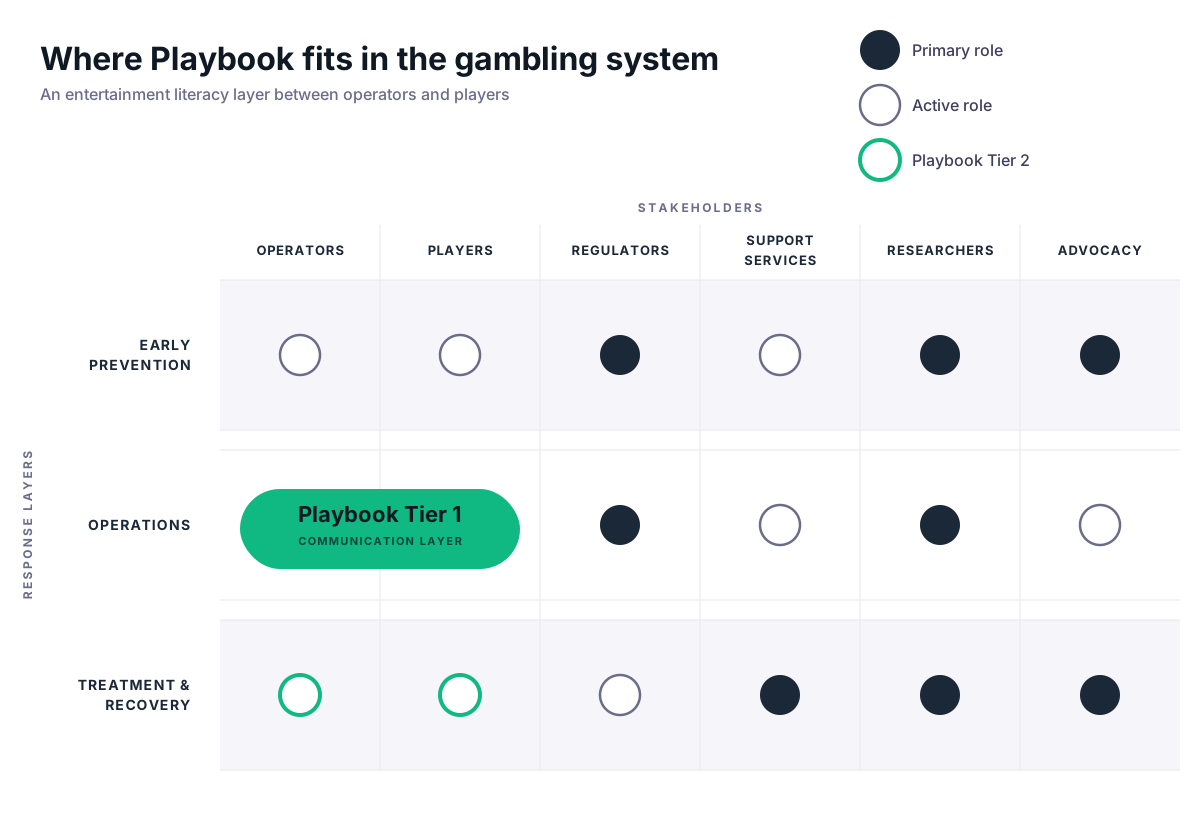
Gambling harm is a shared problem with many actors. Playbook lives in the operations layer – the day-to-day experience of play – where Tier 1 (entertainment literacy, the “Playbook voice”) acts as the communication layer between operators and players. Tier 2 (support and crisis, the “support voice”) extends that same operator-to-player channel into treatment and recovery, connecting players to help if they ever need it. Playbook is one piece of a larger system that also includes regulators, support services, researchers, and advocacy groups.
Entertainment brand          Playbook                    Support services
(casino, sportsbook)        (entertainment literacy)    (helplines, counseling)

"Come play!"            "Know your game."           "We're here when you
                                                     need us."

Excitement               Intelligence & features     Recovery & support
Revenue-focused          Player-focused              Health-focused
Playbook is not the entertainment brand (it doesn’t promote gambling) and it’s not a support service (it doesn’t provide clinical treatment). It’s the entertainment literacy layer between the two – the content that makes players smarter about the games they already enjoy and connects them to support if they ever need it.
Positioning Relative to the Operator
Playbook content should feel like a feature of the operator’s brand – not a regulatory footnote bolted on:
Scroll sideways for all columns. With a keyboard, focus this table area and use the left and right arrow keys. Tab moves to the next control.
| Dimension | Entertainment Brand | Playbook |
|---|---|---|
| Purpose | Engage players with entertainment | Help players get more from the experience |
| Tone | Exciting, aspirational | Confident, witty, informative |
| Visual quality | World-class | Equally world-class |
| Placement | Prominent | Visible and integrated, never buried |
| Design investment | High | Equal |
The key test: If the Playbook content on your platform looks noticeably cheaper, older, or less polished than the entertainment content, you have a brand equity problem. Players read quality signals instantly. When one part of the product looks like an afterthought, they treat it like one.
Positioning Relative to the Industry
Scroll sideways for all columns. With a keyboard, focus this table area and use the left and right arrow keys. Tab moves to the next control.
| Existing Approach | Focus | How Playbook Differs |
|---|---|---|
| GameSense (BCLC/MGC) | On-site advisors, myth-busting | Playbook is a deployable content brand, not an advisor program |
| GambleAware (UK) | Public awareness campaigns, research | Playbook provides operator-level implementation, not mass-market messaging |
| NCPG (US) | Policy advocacy, helpline, campaign kits | Playbook is a complete brand system, not a campaign toolkit |
| Operator-built programs | Custom, variable quality | Playbook is standardized, open-source, marketing-grade |
Value Propositions
For Players
The player value proposition has three facets. They’re the same thing from different angles:
Game intelligence. “I understand how this works now.” Playbook content gives players real knowledge about game mechanics, odds, and probability. Not abstract math – practical intelligence they can use the next time they sit down.
Enhanced enjoyment. “I’m getting more out of this.” When players understand the games better, set budgets that work for them, and play with awareness rather than anxiety, the entertainment experience improves. Informed play isn’t the opposite of fun – it’s a prerequisite for sustained fun.
Better decisions. “I’m making choices I feel good about.” Armed with accurate information and effective tools, players make decisions they don’t regret. They spend what they intended. They play as long as they planned. They walk away when they meant to.
These three – intelligence, enjoyment, decisions – are the same value expressed differently. Use whichever framing resonates with the specific audience and context.
For Operators
The operator value proposition leads with business outcomes, not compliance:
Player retention (lead with this). Players who feel informed and in control have better experiences. Better experiences drive retention. This is not altruism – it’s customer experience strategy. A player who understands the product, sets sustainable budgets, and feels respected by the platform is a player who comes back.
Brand differentiation (lead with this too). In a market where every operator offers roughly the same games, the same odds, and the same promotions, brand is the differentiator. Playbook gives operators a unique brand asset – high- quality player education content that signals “we respect our players enough to invest in their experience.” That signal matters. Especially to the growing segment of players who care about the brands they patronize.
Regulatory compliance (table stakes, not the pitch). Yes, Playbook content satisfies regulatory requirements. But that’s the floor, not the ceiling. Don’t lead with compliance in your business case. Lead with retention and differentiation. Compliance is assumed.
The pitch: “Playbook doesn’t just help you comply. It helps you compete. Your player education content becomes a differentiator, not a cost center.”
Key Audiences
Primary: Players Who Enjoy Gambling
This is the vast majority of your audience and the default voice. These are people who gamble recreationally – they enjoy it, they budget for it, they don’t have significant difficulties with it. They are the norm.
Playbook content for this audience is:
- Informative (makes them smarter about the games they play)
- Entertaining (worth reading on its own merits)
- Empowering (gives them tools and features they actually want to use)
- Never clinical (doesn’t treat them as potential patients)
- Never patronizing (respects their autonomy and intelligence)
Players Who Want to Check In
Some players want to take stock of their play – not because they’re in crisis, but because checking in is a smart thing to do. Like reviewing your monthly spending or checking your fitness stats. Playbook content for this audience is:
- Approachable (“You can read the check-in questions and decide whether to continue.”)
- Non-judgmental (checking in does not equal having a problem)
- Practical (gives them something useful – data, context, features)
- Quick (respect their time; don’t make it a therapy session)
Friends and Family
People who care about someone who gambles. They may have questions. They may want resources. Playbook content for this audience is:
- Informative (here’s how gambling works; here’s what to look for)
- Empowering (here’s how to start a conversation without lecturing)
- Connected (here are support services – for you, not just for the player)
- Calm (not alarmist, not catastrophizing)
Staff
Employees of gambling operators – dealers, pit bosses, customer service reps, cashiers. They interact with players daily. Playbook content for this audience is:
- Training-oriented (practical scripts, conversation guides)
- Confidence-building (you don’t need to be a counselor; here’s what you do need to know)
- Boundary-setting (what’s your role, and what isn’t)
Regulators (Secondary)
Regulators evaluate Playbook content. They don’t consume it as end users. Their concerns are:
- Does this meet jurisdictional requirements?
- Is the information accurate?
- Are support services properly referenced?
- Is the content accessible?
Design for players. Verify for regulators. That’s the order of operations.
All Gambling Verticals
Playbook is vertical-agnostic. The pillars, voice, and brand identity apply across all gambling product types:
- Casino (slots, table games, live dealer)
- Sports betting (pre-match, in-play, futures, props)
- Lottery (draw games, scratch cards, instant win)
- Bingo (online, venue-based, speed bingo)
- Poker (cash games, tournaments, online, live)
Content should be adapted to each vertical’s specific mechanics, terminology, and player behaviors, but the brand system remains consistent. A Playbook quiz about poker odds should feel the same as a Playbook quiz about slot RTP – same voice, same quality, same personality, different subject matter.
When creating content, always specify the vertical. Generic “gambling” content that doesn’t acknowledge the specific game type feels lazy and uninformed – exactly the kind of content Playbook exists to replace.
Tier 1 Content Scope
This section defines the full scope of Tier 1 content – everything this brand book covers.
Game Mechanics and Math
How games work. The actual mathematics. Not simplified to the point of uselessness, but explained in language that doesn’t require a statistics degree.
Includes: house edge, RTP, RNG, probability, odds formats, expected value, variance, wagering requirements, bookmaker margins, payout structures, jackpot odds, game-specific math for every major product type.
Informed Play Habits
Practical habits that enhance the entertainment experience. Framed as features of good play, not restrictions. Be specific – name the behavior, not a generic category.
Includes: setting a budget before you play, checking your session time, reading the odds before you bet, understanding wagering requirements before claiming a bonus, reviewing your activity summary, using deposit limits as budget-setting tools, using session reminders as time-awareness features, pre-session planning, post-session review.
Entertainment Framing
Content that helps players think about gambling as entertainment expenditure. Not as an investment. Not as a way to make money. As a leisure activity with a known cost and an experience worth the price.
Includes: cost-per-hour comparisons with other entertainment, the entertainment budget concept, win/loss expectations, why the experience matters more than the outcome, getting more enjoyment from the games you already play.
Tools and Features
Every player-facing tool – deposit limits, session timers, spending trackers, check-in prompts, cool-off periods, activity dashboards – described as a feature that enhances play. Not as a clinical safeguard. Not as an imposition.
The language rule: if it sounds like something a doctor would prescribe, rewrite it until it sounds like something a product team would ship.
Myth-Busting
Debunking common misconceptions. The bread and butter of Open content. The content type most likely to be shared, most likely to be read voluntarily, and most likely to make a player genuinely smarter.
Includes: hot/cold machines, due numbers, betting systems that “work,” lucky charms and rituals, the belief that you can “feel” when a win is coming, the gambler’s fallacy in all its forms, “the machine is due,” “I’m on a hot streak,” “this system beats the house.”
Shareable and Interactive Content
Quizzes, challenges, calculators, comparisons, and social formats designed to be consumed, shared, and talked about.
Includes: odds quizzes, myth-buster challenges, budget calculators, “how much do you know?” assessments, pre-game group challenges, shareable stats and facts, leaderboards, social-ready formats for every major platform.
Previous: Introduction | Next: Chapter 2 – Brand Personality
Game-example sources and scope
Use the game guides and glossary for the full assumptions behind these examples. The roulette analysis explains wheel, payout and bet exceptions; the RTP explanation distinguishes machine mechanisms within its British scope. The worked arithmetic is illustrative and uses a stated wager denominator. A source or quiz result does not establish an individual player’s outcome.
Confirm actual game rules and service details before adapting the copy. Preserve material conditions when shortening or translating it. Check numbers inside images and downloadable artwork as well as the surrounding text.