Lottery
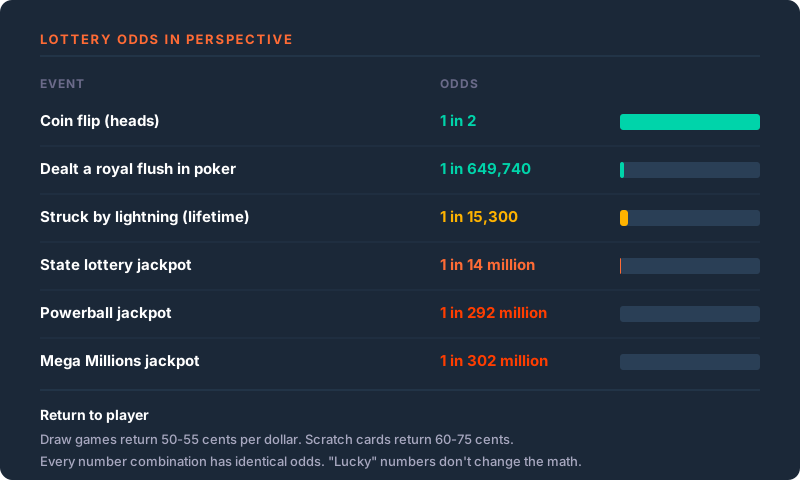
Lottery odds depend on the exact game. A single Powerball entry has a 1-in-292,201,338 jackpot chance under its 5-from-69 plus 1-from-26 format. The current Mega Millions format gives 1 in 290,472,336. Jackpot chance, chance of any prize and expected return are different measures. There is no single return percentage for every draw game or scratch card.
Guide text revised . Sources and assumptions are linked below.
How the game works
Draw games
- Choose the game and draw. Read how many numbers to select, their ranges, whether order matters and whether there is a separate bonus pool. Do not carry one game’s odds into another.
- Choose or generate an entry. A quick pick chooses numbers for you. In a fair uniform draw, any particular valid full combination has the same chance of matching as another valid combination.
- Check the full ticket price. A play, an optional extra and a multi-draw purchase can have different costs. The price of the ticket is not the amount of the advertised jackpot.
- Check the official result and prize tier. A full match may win the jackpot; partial matches can qualify for other prizes according to the particular game.
- Apply the prize terms. Read how multiple winners share, whether a jackpot is quoted as an annuity or cash amount, and how the issuing lottery handles that prize.
Two named formats
Scroll sideways for all columns. With a keyboard, focus this table area and use the left and right arrow keys. Tab moves to the next control.
| Game | Main numbers | Separate bonus number | Published price and feature |
|---|---|---|---|
| Powerball | Five different numbers from 1–69; order does not matter | One from 1–26 | The prize chart’s base example is a $2 play. Check available extras and local terms separately. |
| Mega Millions | Five different numbers from 1–70; order does not matter | One from 1–24 | $5 per play, with a multiplier included under the current published rules. |
References: Powerball’s prize chart and base-play odds and Mega Millions’ current game rules. Mega Millions includes its multiplier in the stated play price. These examples do not establish the price of other lotteries.
Printed scratch cards
A printed scratch card reveals an outcome already encoded on that ticket. Scratching order does not change it. Read the specific game number, ticket price, winning conditions, prize tiers and published odds. An electronic instant game can use a different mechanism; do not assume it is a physical print run.
The California Lottery’s Scratchers directory, for example, distinguishes the odds of any prize and counts of prizes claimed or remaining. A remaining-prize count alone does not give the number of unsold tickets or identify where an unclaimed winning ticket is. Do not turn that count into an exact next-ticket probability without the necessary denominator.
Group play
A group may buy more entries together and divide any prizes according to its agreement. Check which combinations are covered, whether any are duplicates, your share and any fees. More covered outcomes and a smaller share of a win are separate facts; group play does not guarantee a better return per dollar.
Bet types
Scroll sideways for all columns. With a keyboard, focus this table area and use the left and right arrow keys. Tab moves to the next control.
| Purchase | What to check |
|---|---|
| Single entry | One combination for the specified draw, at the stated price. A ticket can contain more than one entry. |
| Multiple entries in one draw | How many distinct full combinations are covered and whether any repeat. |
| Multi-draw | How many future draws are included and the total cost; it does not earn improved odds from previous losses. |
| Quick pick / lucky dip | The generated combination and draw date. A machine-selected valid combination has the same matching chance as a chosen valid combination in a fair uniform draw. |
| Group / syndicate share | Ticket ownership, covered entries, fees and the agreed fraction of any prize. |
| Printed instant ticket | The exact game, price, printed outcome and prize table. |
| Multiplier or extra game | Whether it is optional or included, what it costs and which prizes or drawings it affects. More features do not necessarily improve the jackpot chance. |
The math
Count the full combinations
For a fair unordered selection of k different numbers from n, the number of possible sets is C(n, k) = n! / (k! × (n − k)!). Multiply by the size of an independent bonus pool if one is used. The probability of one particular full combination is one divided by that count.
Scroll sideways for all columns. With a keyboard, focus this table area and use the left and right arrow keys. Tab moves to the next control.
| Stated format | Calculation | Jackpot/full-match probability per single valid entry |
|---|---|---|
| Illustrative six-from-49 draw, no bonus requirement | C(49, 6) | 1 in 13,983,816 |
| Powerball: five-from-69 plus one-from-26 | C(69, 5) × 26 | 1 in 292,201,338 |
| Mega Millions: five-from-70 plus one-from-24 | C(70, 5) × 24 | 1 in 290,472,336 |
The six-from-49 row is a specified mathematical format, rather than a claim about every state or national lottery. Powerball and Mega Millions counts agree with their linked operator prize charts.
Distinct entries and repeated entries
For a draw with N equally likely full outcomes, m different complete entries cover m/N of those outcomes, assuming m is no more than N. Ten different full combinations cover ten times as many jackpot outcomes as one.
Ten copies of the same full combination still cover just one outcome. They may create multiple winning claims under the game’s prize rules, but they do not make that combination more likely to be drawn. Do not apply the m/N jackpot formula indiscriminately to partial-match prizes, whose winning events can overlap.
Matching and sharing are different
In a fair uniform draw, choosing a pattern or a particular valid combination does not change its matching probability. If other entries also match the winning jackpot combination, the prize may be shared. The number of co-winners changes a winner’s amount; it does not change which combination is drawn.
No proportion of quick-pick sales or jackpot winners is assumed here. Claims about particular number choices being popular need evidence from the relevant game and period.
Expected return needs the prize terms
For a fully specified model, expected prize value is the sum of each mutually exclusive outcome’s probability multiplied by its prize value. Expected net return subtracts the ticket cost. Expected return as a percentage divides expected prize value by that cost.
For a jackpot game, the calculation must also account for the jackpot value, possible sharing, cash or annuity valuation and other prize tiers. Powerball and Mega Millions identify California prize differences. A headline annuity amount is not a cash payment made today, and there is no universal cash-to-annuity conversion percentage.
A sales-allocation percentage in a lottery’s accounts describes that accounting measure. It does not by itself establish the expected return of one ticket in a particular draw. Money not paid as prizes can fund other purposes and costs; it is not all operator profit.
An explicitly hypothetical spending exercise
Suppose a fictional game maintained a 55% expected prize return on every purchase. Spending $20 a week for 52 weeks totals $1,040. Under that assumption:
- Expected prize value: $572.
- Expected net loss: $468.
This is arithmetic under an invented constant-return model, not the published return of Powerball, Mega Millions or a scratch-card product. It does not promise what one person receives over a year.
Scratch-card probability and return
The chance of any prize, the chance of a prize greater than the ticket price and expected prize value answer different questions. A payout equal to the ticket cost returns the spend without a profit. Check whether displayed odds refer to the original print run or a remaining inventory, and whether prize values include non-cash awards.
Compare the measures in the game comparison.
Tips for informed play
- Identify the exact game and date. Rules, prices and prize terms can change; an old infographic may no longer describe the ticket being sold.
- Keep costs visible. Include all entries, future draws, extras and group fees in the amount you choose to spend.
- Distinguish chance from prize size. A larger jackpot does not automatically change the chance of matching the numbers. It can change the prize value being offered.
- Check what a statistic measures. Any-prize odds, top-prize odds, remaining unclaimed prizes and expected return are different quantities.
- Treat fresh fair draws as fresh draws. With the same format and a fresh independent random draw, previous losses do not make your next entry due to win. This does not make tickets in a finite scratch-card inventory independent.
Sources and scope
- Powerball prize chart: official matching odds, base-play price and cash/annuity and California qualifications.
- Mega Millions: how to play: official current number pools, $5 price, included multiplier and prize-sharing terms.
- California Lottery Scratchers directory: operator examples of product-specific any-prize odds and claimed/remaining prize counts.
Checked September 5, 2026. Combination counts and the fictional constant-return exercise are independently calculated from their stated inputs. No universal lottery RTP, cash-to-annuity ratio, quick-pick sales share or personal ticket-return forecast is asserted.
Key terms
- Draw
- The selection of winning numbers for the specified game and date.
- Entry / play
- One purchased selection. A physical ticket may contain several plays or several draws.
- Jackpot
- The top prize under the game’s matching and sharing rules.
- Rollover
- Prize money carried to a later drawing under the game’s rules.
- Quick pick
- Numbers generated for the player rather than selected manually.
- Group / syndicate
- People sharing a ticket purchase and any awards under an agreement.
- Scratch card
- A physical instant ticket with a concealed, predetermined outcome.
- Print run
- The set of physical tickets produced for a named instant game.
- Any-prize probability
- The chance of receiving any qualifying award, which may not exceed the ticket cost.
- Expected return
- An average prize value under specified probabilities, amounts and costs; not a promised session result.
- Annuity
- A prize paid over time according to the game’s schedule.
- Cash option
- A stated lump-sum alternative, where offered; use the actual amount rather than a generic percentage of the annuity.
Common myths
What people believe, and what probability tells us.
Myth
A lucky number changes a fair draw
The reality
Every valid full combination has the same matching chance under the stated uniform format.
Myth
Years of losses improve the next ticket
The reality
Previous losses do not change the next fresh independent draw’s probabilities.
Myth
Ten copies mean ten times the jackpot chance
The reality
Duplicate full combinations still cover one jackpot outcome.
Myth
Quick picks have a special matching advantage
The reality
How a valid combination was chosen does not change its probability in a fair uniform draw.
Myth
Any prize means a profit
The reality
A prize can equal or fall below the total amount spent.
Myth
Remaining top prizes reveal exact current odds
The reality
A count of unclaimed prizes alone does not provide the unsold-ticket denominator.
Knowledge check
Pick an answer to reveal the explanation. Nothing is scored or saved.
Part of the Playbook Brand system, the open, public-domain core for player education. You can copy and adapt it under CC0.