Bingo
In bingo, you mark called numbers and try to complete the required pattern. Read the price, participation fee, prize and sharing rules before buying cards. More cards cost more; a simple cards-owned fraction does not universally give the chance of any win. In an ordinary draw without replacement, called balls leave the pool, so consecutive calls are not independent.
Guide text revised . Sources and assumptions are linked below.
How the game works
The basics
A caller or electronic system reveals numbers. You mark matching numbers on your cards and claim according to the game’s rules. The winning pattern might be a line, several lines or a full card. Check whether prizes are separate for each stage, whether winners share, and how long a player has to claim.
In a fair draw without replacement, each remaining ball has the same chance of being called next. A ball already called cannot be drawn again in that game. An online game’s stated draw and reset mechanism should be checked rather than assumed from its appearance.
Playing a session
- Read what the ticket buys. Check which games and patterns it covers, its price, any participation fee, and the prize terms.
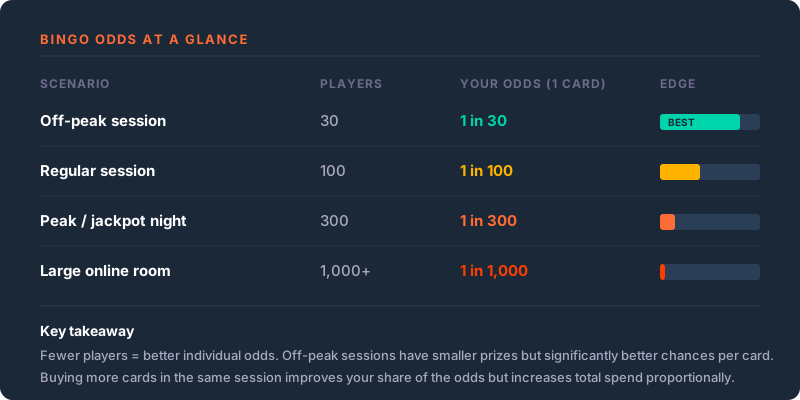
- Choose how many cards to buy. The number of cards and their prices determine your spend. The number of people in the room is not the number of competing cards.
- Follow the calls. Mark matches, or check what an available auto-daub feature does. Some systems mark cards automatically; others require action.
- Complete and claim the pattern. Follow the deadline and claim procedure. Completing a pattern and making a valid claim may both be required.
- Apply the sharing rules. Two or more cards may complete on the same call. A share of a prize can be smaller than the ticket cost, so “won a prize” does not necessarily mean “made a profit.”
Variants
Scroll sideways for all columns. With a keyboard, focus this table area and use the left and right arrow keys. Tab moves to the next control.
| Format | Card and common patterns |
|---|---|
| 75-ball | A 5×5 card, commonly with a free center. Columns use B: 1–15, I: 16–30, N: 31–45, G: 46–60 and O: 61–75. Patterns can include lines, corners, X shapes or blackout. |
| 90-ball | Three rows and nine columns, with 15 numbers and 12 blank spaces. Common prize stages are one line, two lines and a full house. |
| 30-ball / speed bingo | Commonly a 3×3 card using nine numbers, with a full-card objective. Check the particular game’s rules. |
The card format does not by itself tell you the ticket price, prize fund or expected return.
Bet types
Scroll sideways for all columns. With a keyboard, focus this table area and use the left and right arrow keys. Tab moves to the next control.
| Purchase | What to check |
|---|---|
| Single card | Which game and patterns are covered; the total price including fees. |
| Multiple cards | The quantity, price per card, any bundle discount and whether you can track every card. |
| 90-ball strip | A group of cards commonly covering all 90 numbers across the strip. Marking a number somewhere is not the same as completing the winning pattern. |
| Progressive or bonus game | The qualifying pattern, call limit, separate cost, rollover and prize-sharing terms. |
| Side game | Its own rules, price and prize probabilities. A slots or instant-win offer beside bingo is a separate game. |
Prices and fees are product-specific. The arithmetic examples below are illustrative, rather than market price ranges.
The math
Separate fees, stakes and prizes
The operator’s charge and the money funding prizes may be separate. For example, the British Gambling Commission distinguishes participation fees from stakes that are returned as prizes, including permitted rollovers. That is a named jurisdiction’s explanation, not a universal percentage for all online or venue bingo.
Reference: Gambling Commission: how bingo is defined.
For a simplified game in which all payments and a fixed prize fund are known, the share of those payments not returned through that prize fund is:
(total player payments − total prizes) ÷ total player payments
This is an aggregate payment/prize calculation. It is not automatically the operator’s profit, and it is not a complete return calculation if there are additional prizes, subsidies, fees or rollovers outside the example.
Scroll sideways for all columns. With a keyboard, focus this table area and use the left and right arrow keys. Tab moves to the next control.
| Illustrative game | Total player payments | Fixed prizes fully paid | Share of payments not returned in prizes |
|---|---|---|---|
| A | $500 | $400 | 20% |
| B | $10,000 | $8,500 | 15% |
| C | $5,000 | $4,500 | 10% |
These examples are arithmetic, not typical rates for a particular venue or platform. No universal online or venue house-edge range is asserted.
Expected share is different from the chance of winning
Suppose 100 equal-priced cards each have the same expected share of a fixed prize fund before the game, and all prizes are paid with ties shared according to the rules. Under that symmetry assumption, owning 10 cards gives a 10/100 = 10% expected share of the prize fund.
It does not follow that the chance of receiving any prize is exactly 10%. More than one card can win, cards can share numbers and patterns, and a prize can be split. The probability of any win needs the actual cards, patterns and tie rules.
Scroll sideways for all columns. With a keyboard, focus this table area and use the left and right arrow keys. Tab moves to the next control.
| Fixed total of 100 cards | Your cards | Expected share of the fixed prize fund under the stated symmetry assumption | Cost at an illustrative $1 per card |
|---|---|---|---|
| 100 | 1 | 1% | $1 |
| 100 | 5 | 5% | $5 |
| 100 | 10 | 10% | $10 |
| 100 | 50 | 50% | $50 |
The total of 100 is fixed in this table. If your purchase adds cards to the game, the denominator changes too. People may own several cards, so a headcount cannot be substituted for the card count.
For another deliberately simplified example, suppose a game contains just two identical cards and always pays one fixed prize, shared when both complete together. Both cards win a share; each has a 100% chance of a share but receives only half the prize. This is a mathematical counterexample to the claim that owning one of two cards always means a 50% chance of any win, not a description of every commercial bingo game.
What this means for spending
In illustrative Game B above, suppose equal-priced cards also have equal expected prize shares. Then $100 spent on those cards corresponds to $85 expected prizes and $15 expected loss. Those are expectations under the stated model, not promised returns from a session.
Buying more equally priced cards under the same assumptions increases both expected prize money and spend; it does not create a better return per dollar. A smaller game may also have a smaller prize fund. Compare the full price and prize terms before treating fewer participants as a better deal.
Calls within a game are not independent
Consider 75 fair balls drawn without replacement. Before any call, a particular ball has probability 1/75 of being first. After a different ball is removed, the specified ball’s probability of being next is 1/74. If it was already drawn, its chance of being drawn next is zero.
These changes follow from the remaining balls, not from a number being lucky or due. A new game that restores the full pool and randomizes it afresh is a different situation from the next call within the current game.
Compare definitions in the game comparison.
Tips for informed play
- Set a total session spend. Include extra cards, fees, bonus games and side games in the same limit.
- Read the full prize terms. A headline jackpot, the chance of any prize and expected return are different things.
- Count cards, not just people. Multiple cards per player change the competition. A smaller room does not guarantee a better return once price and prizes are included.
- Check side games separately. Their rules and prices may differ from bingo. Do not assume their return is higher or lower without the relevant data.
- Understand marking and claims. Play only as many manual cards as you can follow. Check auto-daub, claim deadlines and sharing instead of assuming they work identically everywhere.
Sources and scope
- Gambling Commission: how bingo is defined. Regulator explanation for Great Britain, distinguishing stakes, participation fees and prize arrangements. It does not substantiate universal online or venue return ranges.
- The payment examples, equal-expected-share examples and 75-ball calculation are explicitly stated mathematical models. They are not measured industry averages or calculations for a named commercial bingo product.
Sources checked September 5, 2026. This educational revision corrects the former universal ranges, card-count win-probability shortcut and within-game independence claim. A particular product still needs its own rules and probability analysis.
Key terms
- Caller
- The person or system announcing the numbers for the game.
- Daub
- Mark a matching number on a card.
- Full house / blackout
- Complete all the required numbers on the card under that game’s rules.
- Line
- Complete the specified row, column or diagonal; the eligible directions depend on the format.
- Pattern
- The arrangement of marked spaces needed for a particular prize.
- Auto-daub
- A feature that marks matches automatically. Check whether claiming still requires action.
- Progressive jackpot
- A prize with stated growth, qualifying, payment and rollover rules.
- Strip
- A group of cards, commonly used in 90-ball bingo.
- Side game
- A separate game with its own payments, probabilities and prize terms.
- Free space
- A space treated as already marked, commonly at the center of a 75-ball card.
- Participation fee
- A charge for taking part; distinguish it from money allocated to prizes.
- Expected prize share
- The average fraction of the prize fund attributed to a card or group under stated assumptions, including the effect of sharing.
Common myths
What people believe, and what probability tells us.
Myth
A lucky seat changes the draw
The reality
A seat does not change a fair drawing mechanism.
Myth
Lucky daubers improve probability
The reality
A marker helps record a match; it does not determine which ball is drawn.
Myth
That number is due
The reality
In a draw without replacement, the next-call probabilities depend on the remaining balls, not a debt owed to a number.
Myth
Your share of the cards always equals your chance of any win
The reality
Shared prizes and card/pattern relationships mean that expected share and win probability need different calculations.
Myth
Experience changes which numbers come up
The reality
Following the game can help avoid missed matches or claims, but does not control a fair draw.
Knowledge check
Pick an answer to reveal the explanation. Nothing is scored or saved.
Part of the Playbook Brand system, the open, public-domain core for player education. You can copy and adapt it under CC0.