Horse Racing
In pari-mutuel racing, wagers of the same type enter the relevant pool, a takeout is deducted and the available money is distributed under that pool’s rules. Fixed-odds wagers use an accepted price and their settlement terms instead. Neither a pool deduction nor a short price guarantees a bettor’s result. Check the specific pool: a more complex bet does not always have a higher takeout.
Guide text revised . Sources and assumptions are linked below.
How the game works
Pari-mutuel / tote betting
Win, Place, Show, Exacta and other bets have their relevant pools; all bets on a race are not simply mixed into one undifferentiated pot. In a basic win pool, the distribution depends on the final amount staked on each eligible outcome after the applicable deduction.
Displayed prices can change as money enters the pool. A price shown when you place a pari-mutuel wager is provisional, rather than a locked payout. Settlement uses the official final pool and result, including the product’s rules for refunds, ties, carryovers and other adjustments.
Reference: NYRA’s wagering explanation and Aqueduct schedule.
Fixed odds
A fixed-odds wager uses the price accepted when it is placed. Later market movement alone does not turn it into a tote payout, but read the provider’s settlement terms for withdrawals, cancellations, dead heats and any other applicable adjustments. A fixed-odds quote is not a published percentage removed from a pari-mutuel pool.
For a simple example without adjustments, fractional odds of 3:1 mean three units of net winnings plus the returned one-unit stake. That is a total return of four units, also expressed as decimal odds of 4.00. A losing wager returns zero in this example.
Following a race
- Identify the event and bet. Check the race, runners, stake per combination and exact finishing requirement.
- Read the relevant price or pool. Note whether the wager is fixed odds or pari-mutuel. A morning-line estimate is not an accepted bet price.
- Check the total ticket cost. Boxing runners or selecting several runners in each leg can create many combinations.
- Wait for official settlement. The apparent finish can be subject to the official result and the wager’s settlement rules.
- Compare money returned with money spent. A winning selection alone does not establish a profit across a ticket or session.
Bet types
Single-race selections
Scroll sideways for all columns. With a keyboard, focus this table area and use the left and right arrow keys. Tab moves to the next control.
| Bet | Common meaning and scope |
|---|---|
| Win | The selected runner finishes first, subject to settlement rules. |
| Place | In the customary US pool, a top-two finish. Other markets use different place terms; check the number of payable places. |
| Show | In the customary US pool, a top-three finish where offered. |
| Across the board | Separate Win, Place and Show wagers. Three unit stakes cost three times one unit. |
| Each-way | A win part and a place part. Check each part’s stake, the payable places and the place-price fraction. |
| Exacta | Select the first two in order. |
| Trifecta | Select the first three in order. |
| Superfecta | Select the first four in order. |
| Quinella | Select the first two in either order, according to that product’s rules. |
More combinations and more races
Scroll sideways for all columns. With a keyboard, focus this table area and use the left and right arrow keys. Tab moves to the next control.
| Purchase | What changes |
|---|---|
| Boxing | Covers different orders of the selected runners. A three-runner exacta box contains six ordered pairs; at an illustrative $1 per pair, it costs $6. |
| Daily Double | Select winners across the two designated legs. |
| Pick 3 / 4 / 5 / 6 | Select winners across the designated number of legs; rules specify any consolation prizes, substitutions or carryovers. |
| Multiple selections per leg | In a basic all-combinations ticket, multiply the selection counts to find its combinations. Two selections in each of three legs make eight combinations. |
| Fixed-odds accumulator | Links selections at the offered combined price. Read void, dead-heat and settlement terms; a leg’s name alone does not establish the combined expected return. |
These descriptions do not establish universal minimum stakes or takeout rates. Check the actual ticket cost before confirming it.
The math
A named takeout schedule
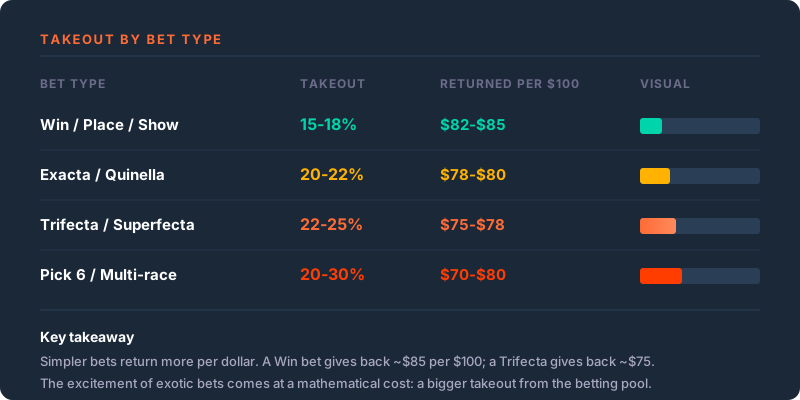
NYRA’s Aqueduct FAQ lists these deductions. They are examples from that named source, not rates for every track or a claim that a particular pool is available today:
Scroll sideways for all columns. With a keyboard, focus this table area and use the left and right arrow keys. Tab moves to the next control.
| Aqueduct FAQ entry | Published takeout |
|---|---|
| Pick 5 | 15% |
| Pick 6, with carryover days listed separately below | 15% |
| Win, Place, Show | 16% |
| Exacta, Quinella, Daily Double | 18.5% |
| Trifecta, Superfecta, Grand Slam, Pick 3, Pick 4 | 24% |
| Pick 6 on carryover days | 24% |
Source: NYRA’s Aqueduct takeout and wagering FAQ, checked September 5, 2026. Use the current venue, pool and date for an actual wager. The 15% Pick 5 entry shows why bet complexity alone does not establish the takeout rate.
A simplified win pool
Assume a $1,000 win pool with 20% takeout. This exercise excludes carryovers, refunds, rebates, minimum dividends, payout rounding and other adjustments.
Scroll sideways for all columns. With a keyboard, focus this table area and use the left and right arrow keys. Tab moves to the next control.
| Runner | Amount staked in this example |
|---|---|
| Horse A | $500 |
| Horse B | $300 |
| Horse C | $200 |
| Total | $1,000 |
The deduction is $200, leaving $800 to distribute in this example.
- If Horse C wins, $800 / $200 = $4 total return per $1 staked on C. That includes the $1 stake, so net winnings are $3.
- If Horse A wins, $800 / $500 = $1.6 total return per $1 staked on A.
More money on a runner, with the total pool otherwise fixed, means a lower dividend for that runner. The stake distribution is not proof of each runner’s true winning probability.
Takeout is not every bettor’s expected loss
The 20% deduction in that example leaves 800 of the original 1,000 units for the winning stakes. It is an aggregate pool calculation. Individual expected returns depend on which runner or combinations are backed, their true chances and the dividends received.
At a fixed total return of $4 per $1 on a win and zero on a loss, expected net return per $1 is true win probability × 4 − 1. Breaking even would require a 25% win probability under these no-adjustment assumptions. The payout alone does not tell you whether that true probability is present.
A carryover, guarantee, rebate, refund or payout rule can change the money distributed or the return for a participant. A posted deduction should travel with its pool definition and conditions; it is not a universal promise that a particular bettor gets 100% minus that deduction back.
Probability estimates are uncertain
Form, field strength, distance, track conditions and other information can inform estimates. A race is not an equal-probability random draw in which every runner necessarily has the same chance. At the same time, a strong record or a favored price does not make the outcome certain.
The usefulness of a forecast must be assessed against the price paid and the full record, not just a selection of wins. A win rate by itself does not establish profitability when payouts and stakes differ.
Compare definitions in the game comparison.
Tips for informed play
- Identify the pricing system. Do not treat a provisional tote quote as fixed odds, or a fixed-odds price as a published pool takeout.
- Read the named pool’s conditions. Check the source date, carryover treatment and actual venue instead of applying a broad straight-versus-exotic ranking.
- Count the combinations. A box or multi-leg selection may cost much more than its base unit stake.
- Treat forecasts as estimates. Review all results, stakes, prices and any fees if assessing a claimed record. A winning screenshot is incomplete evidence.
- Track the total session spend. Eight wagers at an illustrative $5 each total $40; additional combinations and bets add to that. This is arithmetic, not a typical day-at-the-track cost estimate.
Sources and scope
- NYRA: wagering information and Aqueduct takeout. Named operator explanation and schedule, including the separate Pick 6 carryover-day rate. It is not a universal racing schedule or a new legal review of another venue.
- The $1,000 pool, fractional/decimal payout, ticket-combination and spending exercises are explicitly simplified mathematical examples. They do not assert an actual runner’s winning probability or a guaranteed payout from a real event.
Checked September 5, 2026. Each real product needs its own current prices, pool rules and settlement terms.
Key terms
- Pari-mutuel / tote
- A pool-based system with distributions determined under the pool’s final settlement rules.
- Takeout
- The stated deduction from the relevant pool; distinguish it from one bettor’s expected net result.
- Fixed odds
- An accepted price for the wager, subject to the provider’s settlement terms.
- Net winnings
- The gain on a winning wager after excluding the returned stake.
- Total return
- The money returned on settlement, including any returned stake.
- Morning line
- A preliminary price estimate; it is not necessarily the final tote price or an accepted fixed-odds offer.
- Post time
- The scheduled race start. Check the actual wagering cutoff and official settlement rather than treating a displayed time as a payout guarantee.
- Form
- Information about previous performances, used as context for an uncertain forecast.
- Each-way
- A win wager and a place wager, with both parts’ costs and terms to check.
- Carryover
- Pool money carried into a later qualifying event under the specified rules.
- Dead heat
- A tied finishing result whose effect on a wager depends on the settlement rules.
- Breakage / rounding
- A rule for rounding a dividend; it can affect the exact money paid.
- Going
- A description of the racing surface or conditions.
- Stewards
- Officials involved in reviewing incidents and confirming results.
Common myths
What people believe, and what probability tells us.
Myth
Every exotic bet has a higher takeout
The reality
A named schedule can have lower multi-race rates and different carryover-day rules.
Myth
A 20% pool deduction means I personally lose exactly 20%
The reality
A pool allocation is different from an individual result or expected return.
Myth
A short-priced runner is certain to win
The reality
A price does not eliminate uncertainty.
Myth
All horses have an equal chance because the outcome is uncertain
The reality
Uncertainty does not imply equal probabilities.
Myth
A successful tip proves a profitable service
The reality
A full record must include losing selections, stakes, available prices and fees.
Myth
Winning one part proves the whole ticket made money
The reality
Compare every settled return with the total ticket cost.
Knowledge check
Pick an answer to reveal the explanation. Nothing is scored or saved.
Part of the Playbook Brand system, the open, public-domain core for player education. You can copy and adapt it under CC0.