Baccarat
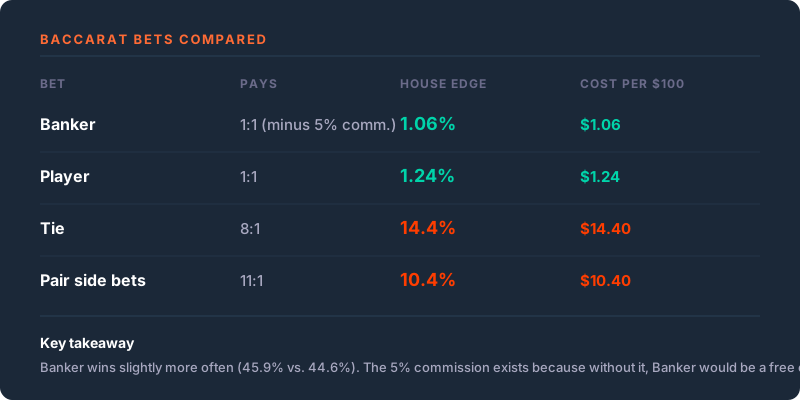
In punto banco, you choose a bet and fixed dealing rules determine the hands. In the eight-deck example here, Banker has a 1.06% house edge after 5% commission on wins; Player has 1.24%. Tie has 14.36% at an 8:1 payout, or 4.84% at 9:1. These are averages per initial wager, including pushes, rather than predictions for your session.
Guide text revised . Sources and assumptions are linked below.
How the game works
Card values
- Ace counts as 1; cards 2 through 9 count at face value.
- 10, Jack, Queen and King count as 0.
- Add the card values and keep the last digit. A 7 and an 8 make 15, which counts as 5. The highest possible total is 9.
Playing a round
- Choose your wager before the deal. Banker and Player are names for two table positions. You can bet on either hand, or on a Tie.
- Two cards go to each hand. The cards, rather than the identity of the dealer or bettor, determine the totals.
- Check for a natural. If either initial hand totals 8 or 9, both hands stop drawing. Compare the totals: 9 beats 8; equal totals tie. A natural does not always win against another natural.
- Apply the drawing rules. If there is no natural, Player and then Banker draw or stand according to the rules below. Neither the bettor nor dealer chooses a strategy for that hand.
- Compare the final totals. The higher total wins. Equal totals produce a Tie. Winning wagers are settled at the table’s stated payouts.
The third-card rules
After checking for naturals, Player draws on 0–5 and stands on 6–7. If Player stands, Banker draws on 0–5 and stands on 6–7.
If Player draws a third card, use its card value, rather than Player’s new total, in this table:
Scroll sideways for all columns. With a keyboard, focus this table area and use the left and right arrow keys. Tab moves to the next control.
| Banker’s two-card total | Draw a third card when Player’s third-card value is |
|---|---|
| 0–2 | Any value |
| 3 | Any value except 8 |
| 4 | 2–7 |
| 5 | 4–7 |
| 6 | 6–7 |
| 7 | Never; stand |
These rules apply after the natural check. A Banker natural does not draw, even if another row would otherwise suggest drawing.
Variants
Scroll sideways for all columns. With a keyboard, focus this table area and use the left and right arrow keys. Tab moves to the next control.
| Version | What to check |
|---|---|
| Punto banco | Automatic drawing rules; this guide’s calculations use eight decks. |
| Mini or midi baccarat | Table size and card handling can differ. Matching rules, deck count and payouts are needed for matching probabilities. |
| Chemin de fer or baccarat banque | Player/banker roles and drawing choices differ; do not reuse the punto banco figures without checking. |
| No-commission baccarat | Removing commission is often paired with a reduced payout or a push on a particular Banker outcome. Read the complete rule and payout schedule. |
Rule reference: eight-deck baccarat rules and analysis.
Bet types
Main wagers: eight-deck example
The payouts below are net winnings. On a winning wager, the original stake is returned as well. A push returns the stake without a profit.
Scroll sideways for all columns. With a keyboard, focus this table area and use the left and right arrow keys. Tab moves to the next control.
| Bet | Winning condition | Net payout | House edge per initial wager |
|---|---|---|---|
| Banker | Banker finishes with the higher total | 0.95:1 after 5% commission on wins; Tie pushes | 1.06% |
| Player | Player finishes with the higher total | 1:1; Tie pushes | 1.24% |
| Tie at 8:1 | Equal final totals | 8:1; other outcomes lose | 14.36% |
| Tie at 9:1 | Equal final totals | 9:1; other outcomes lose | 4.84% |
For example, a $100 winning Banker wager produces $95 net winnings plus the returned $100 stake. A $100 winning Tie wager at 8:1 produces $800 net winnings plus the returned stake. “8 to 1” and “9 for 1” describe the same total return; “9 to 1” is a different payout.
Side bets
Banker Pair and Player Pair commonly ask whether the first two cards of the named hand have the same rank. With eight decks, the second card matches the first card’s rank in 31 of the remaining 415 positions. At an 11:1 net payout, that gives a 10.36% house edge for each of these pair bets. A different payout changes the edge.
Other offers, such as Either Pair, Big/Small or named progressive bets, need their own winning conditions and payout tables. Their names alone do not establish a percentage. Do not apply the Banker figure to a side bet or claim every side bet has the same edge.
Payout and outcome reference: baccarat return tables.
The math
The denominator matters
For the initial eight-deck shoe in the cited analysis, Banker wins about 45.86% of all hands, Player about 44.62%, and Tie about 9.52%. If ties are excluded, Banker wins about 50.68% of the remaining, decided hands. That last figure is not Banker’s probability of winning any hand.
House edge is the negative of expected net return divided by the initial stake. For a one-unit wager, let B, P and T be the probabilities of a Banker win, Player win and Tie:
- Banker expected net return: 0.95 × B − P; ties contribute zero.
- Player expected net return: P − B; ties contribute zero.
- Tie paying 8:1: 8 × T − (1 − T) = 9 × T − 1.
- Tie paying 9:1: 9 × T − (1 − T) = 10 × T − 1.
At 8:1, a Tie bet would need to win 1 in 9 times, about 11.11%, to break even. The actual eight-deck probability is about 9.52%. The house edge comes from the expected-return equation, not simply subtracting those two probability percentages.
A spending example
Under the stated eight-deck assumptions, $100 of total Banker wagers has an expected loss of about $1.06. The corresponding examples are $1.24 on Player, $14.36 on Tie at 8:1, and $4.84 on Tie at 9:1. The $100 is total wagered, which can include money staked again after a return; it is not necessarily your starting bankroll.
Actual results vary. These expected values do not promise a particular loss or return over an hour, a session or a fixed number of hands.
A shoe changes as cards leave it
In a game dealt without replacement, cards already dealt are no longer in the shoe. Successive hands from that shoe are therefore not independent. The remaining card composition can change the probabilities; the initial-shoe averages above are not exact conditional probabilities for every later hand.
A scoreboard usually records outcomes, rather than every card remaining in the shoe. A run of Banker results alone is not a reliable reason to claim Banker must continue or Player is due. “Cards are removed” and “a streak guarantees a useful prediction” are different claims. Some electronic games use different dealing or reset rules, which should be stated explicitly.
Reference: the effect of removing cards from an eight-deck shoe. The changing probabilities can be checked directly in that analysis; no profitable betting system is inferred here.
Compare the stated examples in the game comparison.
Tips for informed play
- Read the payout first. Among Banker, Player and Tie under this guide’s rules, Banker has the lowest expected loss per initial wager. That is not a guarantee of winning or a statement about every side bet or variant.
- Check “to” and “for.” An 8:1 Tie payout has a different edge from 9:1. Confirm whether the displayed payout includes your returned stake.
- Keep scores in perspective. A finite shoe changes, but a run on the display does not make the next result certain. Avoid increasing a wager because a result feels due.
- Treat side bets as separate products. Read their conditions, net payouts and edge calculation rather than borrowing the main game’s percentage.
- Set a spending and time limit. For an illustrative 40 hands at $25 each, total wagers are $1,000. At 80 hands they are $2,000. Those are arithmetic examples, not measured dealing speeds or promised session losses.
Sources and scope
- Michael Shackleford: baccarat rules and eight-deck return tables. Original mathematical analysis, including the 11:1 pair example. House edges here are recalculated from the stated counts and net payouts before rounding.
- Michael Shackleford: effects of removing cards from an eight-deck shoe. Original mathematical analysis supporting the finite-shoe qualification.
Sources checked September 5, 2026. This is a revision of the Playbook RG educational guide, not approval of a particular operator’s game. The source and quick-reference downloads carry the same stated figures. Artwork and separately published feeds have their own revision histories.
Key terms
- Natural
- An initial two-card total of 8 or 9. Both hands stand when either has a natural; compare their totals to settle the round.
- Banker / Player
- Names of the two hands and corresponding wagers, rather than particular people.
- Commission
- A charge on a winning wager. This guide’s Banker example charges 5% of the otherwise even-money win.
- Punto banco
- A version of baccarat in which the drawing rules determine whether each hand takes a third card.
- Third-card rule
- A fixed instruction based on the initial totals and, where relevant, the value of Player’s third card.
- Tie / push
- A Tie is equal final totals. In the main-wager example, Banker and Player push on a Tie; a separate Tie bet wins.
- Shoe
- The device holding the cards to be dealt. This guide’s numerical examples begin with eight decks.
- Scorecard
- A record of earlier results. An outcome record is not a complete count of the remaining cards.
- Burn cards
- Cards removed from use during the dealing procedure. Removing cards changes the available composition; it is not a fresh shuffle before each hand.
- Mini baccarat
- A table format. Check its actual deck count, drawing rules and payouts before assigning probabilities.
Common myths
What people believe, and what probability tells us.
Myth
A betting system removes the house edge
The reality
Changing stake sizes does not change the payouts or probability of the wager you place.
Myth
The dealer can choose a lucky draw
The reality
In punto banco, the drawing rules specify the next action.
Myth
Scorecards guarantee the next result
The reality
A result streak is not a reliable rule for predicting the next hand; cards remaining in a finite shoe still matter.
Myth
Banker always wins
The reality
Banker wins about 45.86% of all initial-shoe hands in this example; ties are a separate outcome.
Myth
No commission means better odds
The reality
Check the replacement payout and push rules before comparing expected loss.
Knowledge check
Pick an answer to reveal the explanation. Nothing is scored or saved.
Part of the Playbook Brand system, the open, public-domain core for player education. You can copy and adapt it under CC0.